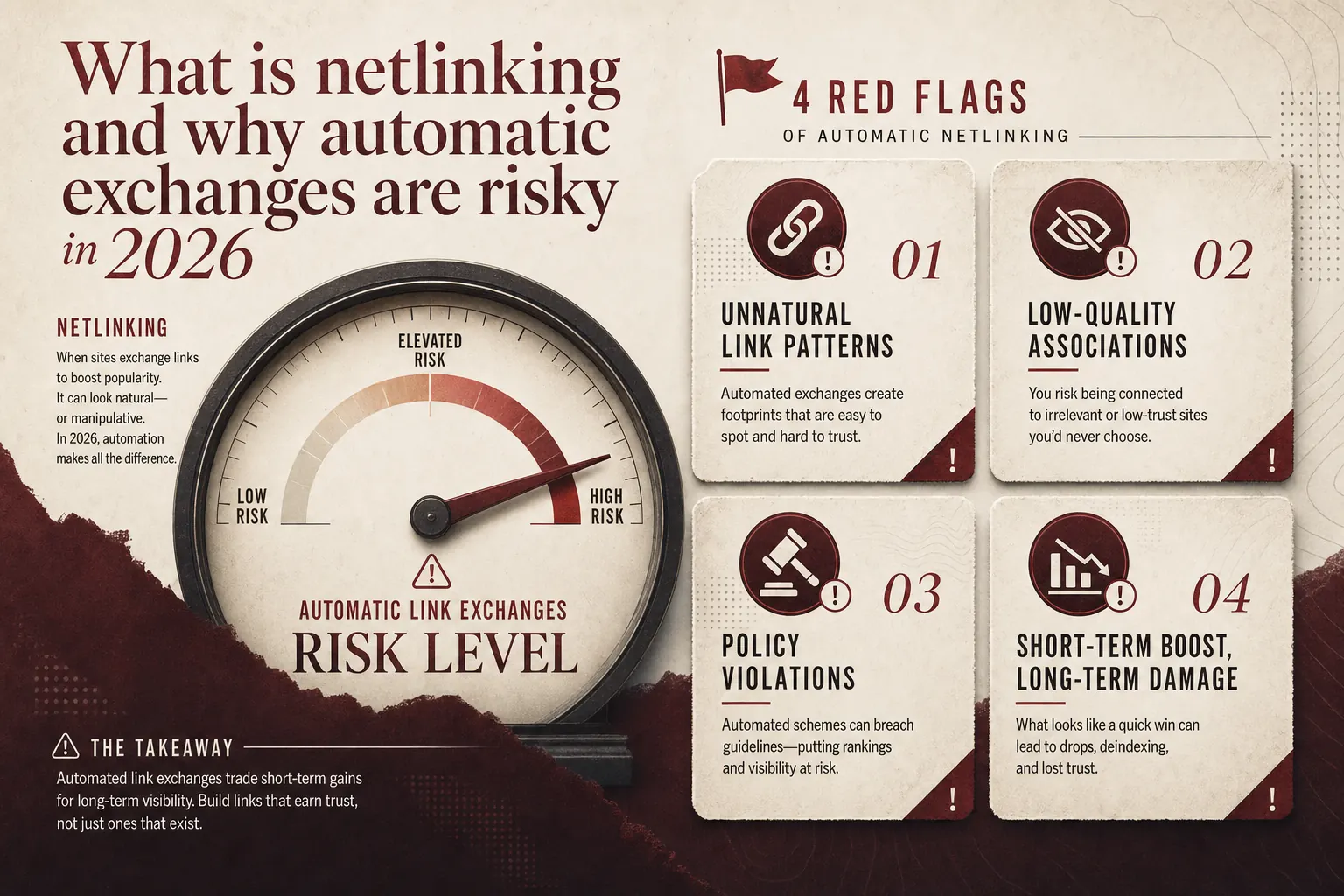
In May 2026, several SEO platforms include automatic backlink exchange systems as a flagship feature. The premise seems appealing: join a network, get links automatically, improve your authority without manual effort. The algorithmic reality is more nuanced, and the risk is real.
This article explains precisely what netlinking is, how these automated exchanges work, what Google officially says about them, and how to build a sustainable link strategy without exposing your domain to a penalty.
What is netlinking?
Netlinking, also called link building, refers to all actions aimed at obtaining inbound hyperlinks (backlinks) from other sites to yours. These links constitute one of Google's oldest and most robust ranking signals.
The intuition behind this signal is simple: if a reference site in your domain points to your page, that's a vote of confidence. The more qualified votes you receive. From relevant, authoritative, thematically coherent sites. The more Google considers your content worthy of good positioning.
The three pillars of a quality backlink
Not all backlinks are equal. Google evaluates each link along three main dimensions:
- Thematic relevance: a link from a site on the same topic as yours weighs more than a link from an unrelated blog.
- Source site authority: a link from a recognized publication (national press, institution, specialized media) is worth more than a link from a low-traffic site.
- Editorial context: a link naturally inserted in relevant content, with a coherent anchor, is more valued than a footer link or a « partners » block.
How automatic link exchanges work
The mechanism of automatic exchange platforms generally follows the same pattern:
- You register your site on the platform.
- An algorithm identifies other members considered « compatible » (same language, similar topic, similar DA).
- Link exchanges are proposed or made automatically: you publish a link to another member, they publish a link to you.
- The network grows: the more members, the more links each site receives.
Key point: The automated nature of these exchanges. And especially the fact that they occur between members of the same infrastructure. Creates precisely the type of pattern Google seeks to detect. It's not the exchange itself that's problematic, but its systematic and artificial character.
What Google says officially
Google's positions on artificial link schemes are public, consistent since 2012, and have not varied in substance. The reference texts:
Google Spam Policies, « Link spam »
Published on developers.google.com/search/docs/essentials/spam-policies, the document explicitly lists as violations:
"Buying or selling links that pass PageRank. This includes exchanging money for links, or posts that contain links; exchanging goods or services for links; or sending someone a 'free' product in exchange for them writing about it and including a link."
"Excessive link exchanges ('Link to me and I'll link to you') or partner pages exclusively for the sake of cross-linking."
The mention « excessive » is important: a one-off link exchange between two coherent editorial partners is not in itself problematic. Systematic, automated exchanges within a closed network are.
Penalty history: Penguin to today
Key takeaway: Since Penguin 4.0 in 2016, Google devalues suspicious links rather than always triggering an explicit penalty. This means an exchange network can « work » for a time. Until a Core Update re-evaluates signals and erases accumulated benefit, sometimes all at once.
How Google detects artificial networks
| Signal | What Google observes | Risk |
|---|---|---|
| Acquisition speed | 50 new backlinks in 2 weeks on a domain that had none | High |
| Anchor consistency | 70% of anchors identical or very similar | High |
| Shared infrastructure | Links from sites on same IPs or sharing same code/template | High |
| Thematic incoherence | Accounting site receives link from unrelated gardening blog | Medium |
| Synchronized timing | Multiple sites receive links in the same time window | Medium |
| Systematic reciprocity | Site A links to Site B, Site B links to Site A, across dozens of similar pairs | High |
Concrete risks for your site
Risk 1: Algorithmic devaluation (silent)
Since Penguin 4.0, Google can simply ignore links it deems artificial, without triggering a visible penalty. Your site doesn't drop, but the link benefit doesn't exist (or disappears after a Core Update). You pay for infrastructure that produces no effect, or worse, whose effect is temporary and collapses during a Core Update.
Risk 2: Manual penalty (visible)
If a Google reviewer identifies your backlink profile as manipulative, a manual action may be applied. Consequences: position drops on all or certain queries, notification in Search Console, mandatory reconsideration process. Return to initial positions can take 3 to 12 months (source: Search Engine Journal, case studies published 2023-2025).
Risk 3: Exposure during future Core Updates
An artificial backlink profile is a time bomb. It can remain dormant for months, then be re-evaluated during a Core Update that affects your sector. The risk isn't immediate, it's in exposing your domain to unpredictable future instability.
Cicéro analyzes your link profile, identifies risks and proposes a clean netlinking strategy adapted to your sector.
Get my free articleFree articleHow to get clean backlinks in 2026
Citation-worthy reference content
Publish comprehensive guides, case studies, and original data that other authors will naturally want to cite. The most scalable long-term mechanism.
Press and specialized media
Expert contributions in sector publications (interviews, guest articles on high-DR sites, mentions in in-depth articles). One link from a recognized media outlet is worth dozens of network links.
Thematic editorial partnerships
Collaborations with complementary (non-competing) players in your ecosystem. The exchange must be justified by real editorial coherence, not an automatic agreement.
Broken link building
Identify broken links on authoritative sites in your sector, propose your content as a replacement. Time-consuming but high success rate and zero risk.
Free resources and tools
Publish a free tool, template, or calculator that other sites naturally reference. Creates a passive, sustainable inbound link flow.
Institutional relations
Partnerships with trade associations, chambers of commerce, universities. These .org/.edu/.gov domains have strong authority and constitute links that are hard to contest.
To go further: The complete SEO + GEO audit guide for French brands covers backlink profile analysis among its 9 evaluation dimensions. A useful framework before launching a link building campaign.
What this article doesn't cover
Scope and limits
- This article doesn't cover backlink tracking tools or their scoring methodology, that's a separate topic.
- It doesn't cover post-penalty recovery strategies (Disavow + reconsideration process), these deserve a dedicated article.
- It doesn't evaluate specific platforms or tools: examples are kept generic to maintain objectivity.
- Local netlinking (NAP citations, local directories) follows partially different rules, not covered here.
Frequently asked questions about netlinking
What is netlinking in SEO?
Netlinking (link building) refers to all practices aimed at obtaining inbound links (backlinks) from other sites to yours. These links are interpreted by Google as votes of confidence: the more relevant and authoritative links a site receives, the more likely it is to rank well in search results.
Why are automatic backlink exchanges dangerous?
Automatic backlink exchanges between platform members constitute what Google calls a « link scheme. » This directly violates Google Spam Policies. When Google detects these patterns, it can devalue the links or apply a manual penalty. Penguin updates (2012, 2016) and recent Core Updates have consistently targeted these practices.
Can Google detect backlink networks between clients of the same platform?
Yes. Google's algorithms identify abnormal patterns: unusual acquisition speed, repetitive anchors, links from sites sharing the same infrastructure. A closed network between platform clients generates exactly this type of signal. Google Search Central explicitly documented this in its Spam Policies.
How do you get clean backlinks in 2026?
Sustainable methods: (1) reference content others cite naturally, (2) press relations and specialized media mentions, (3) thematically coherent editorial collaborations, (4) broken link building, (5) free resources that attract natural links. Slower, but durable and risk-free.
Is a backlink penalty recoverable?
Yes, but the process is long. Options: (1) disavow suspicious links via Search Console's Disavow tool, then submit a reconsideration request; (2) wait for Google to algorithmically re-evaluate after correction. Return to initial positions can take 3 to 12 months.
Sources and references
- Google Search Central, Spam Policies (Link spam): developers.google.com/search/docs/essentials/spam-policies
- Google Search Central Blog, Penguin 1.0 (April 2012)
- Google Search Central Blog, Penguin 4.0 (September 2016)
- Search Engine Land, Core Updates 2024-2025 coverage
- Search Engine Journal, Manual penalty case studies (2023-2025)
- Search Engine Journal, « We Studied 11.8 Million Google Search Results ». Large-scale backlink profile analysis, 2024

SEO and GEO strategy consultant for French brands. I run Cicéro, an agency specializing in organic visibility on Google, ChatGPT and AI generative engines. This article reflects our field approach. No affiliation with tools or platforms mentioned.
View LinkedIn profile