
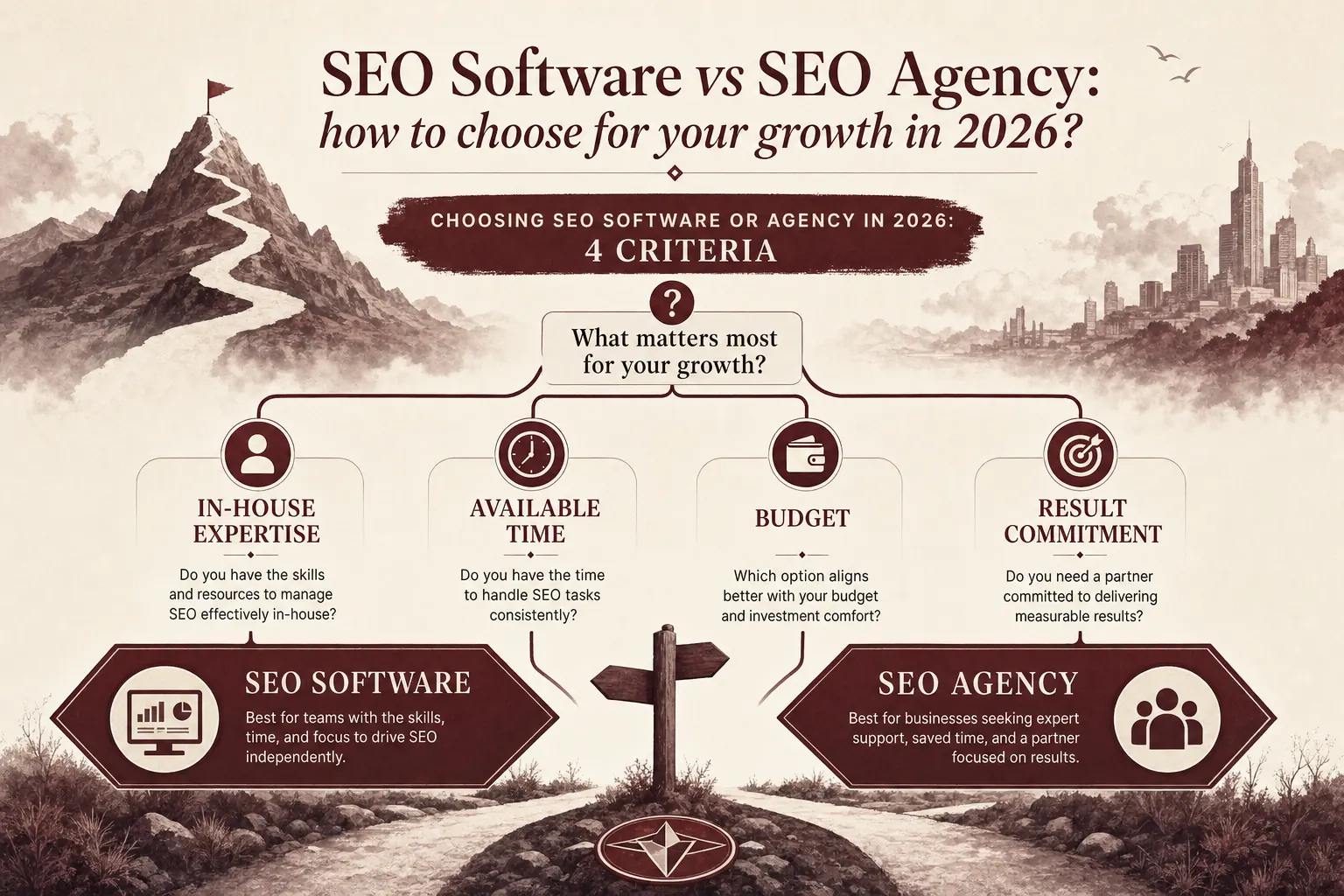
In 2026, the self-service SEO tool market has exploded. Dozens of platforms promise AI articles, automated audits, and backlinks in a few clicks. Often for less than €100 per month. On the other side, SEO agencies continue delivering human expertise at rates some businesses find intimidating. Which option is actually right for you? Neither is universally superior, and the answer depends on five structural criteria this article breaks down one by one.
TL;DR, The essentials in 30 seconds
- SEO software = self-service tool. Gives you data and recommendations. You execute.
- SEO agency = managed service. Strategy, content production, and technical execution handled for you.
- Software works if you have an in-house SEO expert or are in a learning phase with a low-competition site.
- Agency works if you want results without dedicated internal resources, on competitive markets or with real conversion stakes.
- Risk #1 with self-service AI tools: mass AI-generated content without human supervision degrades your site's E-E-A-T. Documented in Google's Search Quality Rater Guidelines (2024).
SEO Software and Agency: what each actually does
SEO software is a self-service tool that provides data (rankings, keywords, backlinks, audits) and sometimes generates AI content. But interpretation and execution remain your responsibility. An SEO agency handles strategy, content production, and technical execution, and is accountable for results.
What SEO software does
Modern SEO software typically offers four types of functionality:
- Ranking data: tracking positions on target keywords, changes over time, comparison with competitors.
- Automated technical audit: detection of 404 errors, speed issues, missing tags, non-indexed pages.
- Keyword research: estimated search volumes, query suggestions, organic competition analysis.
- AI content generation: automatic or AI-assisted writing of articles, meta tags, and headings. A feature offered by an increasing number of platforms since 2024.
What software doesn't do: make strategic decisions, arbitrate between two contradictory options, adapt to your market's specific dynamics, or produce E-E-A-T content with verifiable field experience. These tasks require human judgment that automated tools don't replace, even in 2026.
What an SEO agency does
- Editorial strategy: what content architecture, which queries to prioritize based on real ROI, what angle to differentiate your pages from the competition.
- Quality content production: long articles with named sources, field expertise, identifiable author. The E-E-A-T signals Google evaluates.
- Technical execution: code corrections, Core Web Vitals optimization, JSON-LD schema implementation, redirect management.
- Editorial backlinks: press relations, partnerships, editorial placements in relevant media. The only backlinks without penalty risk.
- Reporting and adjustments: monthly results analysis, strategy pivot if an angle isn't converting, escalation on Search Console anomalies.
The fundamental dividing line: software gives you instruments, an agency gives you results. This seems simple, but it has major implications for total cost and accountability for the absence of results.
Full comparison table
The main difference between SEO software and an SEO agency is responsibility for execution: software gives you the data, you're accountable for results; an agency is responsible for execution and results.
| Dimension | SEO Software | SEO Agency |
|---|---|---|
| Responsible for execution | You (or your team) | The agency |
| Monthly cost | €50–500/month | €800–5,000/month |
| Real cost (time included) | Subscription + the internal time needed to act on the data | €800–5,000/month (all-inclusive) |
| Internal expertise required | High (to exploit the data) | Low (brief + validation) |
| Content quality produced | Depends on who writes (the tool gives recommendations) | High if quality agency (sources, author, expertise) |
| Time to first result | 6-18 months (with good execution) | 3-8 months (managed execution) |
| Market adaptability | Low (generic algorithm) | High (custom strategy) |
| Google penalty risk | Low if white hat practices (content quality, no link schemes) | Low if white hat practices |
| AI visibility (GEO) | Not covered by most software | Covered if SEO+GEO specialized agency |
| Best for | In-house SEO expert, low-competition site, learning | SMB without SEO resources, competitive market, conversion goals |
This table describes analysis tools, the most common kind of SEO software. Automation platforms such as Sorank work differently: they write and publish articles on autopilot for a monthly subscription, so they need little of your time, but the system decides topics and keywords (sorank.com, checked 30 September 2026).
The 5 decisive criteria for choosing
The choice between SEO software and an SEO agency comes down to 5 criteria: your in-house expertise level, your market competitiveness, your objectives (traffic vs conversion), your available time, and your risk tolerance.
Criterion 1, Do you have SEO expertise in-house?
This is the most determining criterion. SEO software is only as good as the person using it. Knowing that a page scores 67/100 isn't enough. You need to understand why, what to correct first, and how to write corrective content. Without this expertise, SEO software becomes an expensive dashboard nobody reads.
Criterion 2, How competitive is your market?
On low-competition queries (long-tail, niche sector, precise geolocation), well-used SEO software can produce results in 6-12 months. On medium to high-competition queries. « SEO agency France », « SMB billing software », « Paris lawyer ». You're up against sites with tens of thousands of pages and years of editorial backlinks. No software compensates for this asymmetry without a custom strategy and professional execution.
Criterion 3, Is your goal traffic or conversion?
SEO software generally optimizes for organic traffic. But traffic that doesn't convert is opportunity cost. A specialized agency can align content strategy with commercial-intent queries. Those that precede a purchase decision. And build a coherent conversion path across pages. This level of personalization exceeds generic software capabilities.
Criterion 4, How many hours can you dedicate monthly?
An analysis tool only produces value if someone acts on its recommendations, which takes regular time from a competent profile. If this time doesn't exist in your organization, the software will stay unused. Count the opportunity cost: at €80/h, 10 monthly hours would already be €800, close to the price of an entry-level SEO agency. Automation platforms that write and publish on autopilot need far less of your time; the trade-off is that the system chooses topics and keywords.
Criterion 5, Your risk tolerance
Certain practices carry documented risks under Google Search Central's spam policies:
- Mass AI content generation without supervision, a signal of content without demonstrable expertise (E-E-A-T).
- Reciprocal link-exchange networks, where sites swap links with each other. Explicitly categorized as « link schemes » in Google's policies.
- Over-optimized anchor text on exact-match keywords, manipulation signal detectable by Penguin.
30-minute free diagnosis, we analyze your site, your market, and tell you honestly which option fits your profile.
Book a callReal costs: the full calculation
The listed price of SEO software (€50-500/month) doesn't reflect the total cost. Adding the internal time required for effective use, both options often become comparable for an SMB. At very different expertise and results levels.
| Cost item | Monthly estimate |
|---|---|
| Software subscription | €100–300 |
| Internal time (10h × €80/h) | €800 |
| Outsourced content production | €300–600 (2-4 articles) |
| Technical corrections (developer) | €200–400 |
| Real total monthly | €1,400–2,100 |
For comparison, an entry-level SEO agency typically costs €800-1,500/month all-inclusive. The total cost difference is smaller than the headline subscription prices suggest. But the expertise and accountability are structurally different.
Underestimated risks of each option
Each option carries specific risks that solution vendors (software or agencies) rarely mention in their sales pitches.
Risks of self-service SEO software
The E-E-A-T risk of mass AI content. Google's Search Quality Rater Guidelines (2024 update) explicitly evaluate content on Experience, Expertise, Authority, and Trustworthiness criteria. Content automatically generated by AI, without an identifiable author and without verifiable field experience, is structurally weaker on these criteria. On competitive queries, this content may rank temporarily then drop during algorithmic updates.
The link-exchange risk. Excessive reciprocal link exchanges (« link to me and I'll link to you ») are explicitly classified as a « link scheme » in Google's spam policies. Before switching on any link feature in a tool, read its terms to see whether links are reciprocal. Sorank, for example, states in its Terms of Use (updated 21 September 2026) that its opt-in network sends links one way and is not a link exchange.
The false-control illusion. An SEO dashboard creates the illusion of control. You see data, you track scores. But without expertise to interpret signals and prioritize actions, this monitoring produces no results. This illusion can delay the decision to hire an expert by 12-18 months.
Risks of SEO agencies
The unfulfilled promise risk. Some agencies sell results in 2-3 months on competitive queries, a structurally impossible promise. The realistic timeline for significant improvements is 4-8 months for moderately competitive queries, 6-16 months for very competitive ones (source: Google Search Central documentation on indexing and ranking timelines). Require a contract with contractual KPIs and milestones at 3, 6, and 12 months.
The production-without-strategy risk. Some agencies produce content in volume without strategic architecture. Articles that don't interconnect, targeting queries with no commercial potential, not optimizing for conversion. Verify the agency proposes a documented editorial plan before signing.
The hybrid approach: when both combine
The hybrid approach, agency for strategy and production, software for monitoring and data. Is the most common model in organizations with an established marketing team. It combines agency human expertise with tool data granularity.
In practice, a hybrid approach works like this: the agency defines editorial strategy, produces E-E-A-T content, and handles priority technical aspects. The SEO software (or free Google Search Console) is used for daily position tracking, anomaly detection, and reporting. Software data feeds monthly steering meetings with the agency to adjust priorities.
Verdict: who needs what
Neither SEO software nor an SEO agency is universally superior. The choice depends on your profile: in-house expertise, market competitiveness, and real objective, traffic or conversion.
Choose SEO software if...
- You have an in-house SEO expert who will actively use it
- Your site operates on low-competition queries
- You're in a learning phase (side project, early-stage)
- You have an established content team that needs data guidance
- Your budget is under €500/month and you have time
Choose an SEO agency if...
- You don't have in-house SEO expertise
- Your market is competitive and conversion stakes are high
- You need results in 6-12 months, not 18-24
- You want to cover SEO and GEO (AI visibility)
- Your budget exceeds €1,000/month and you prefer to delegate
The case where an agency is structurally better
For a business without in-house SEO resources, seeking qualified leads in a competitive market, an agency producing quality E-E-A-T content with an integrated GEO strategy offers better ROI than self-service software, even well-used software. The reason is structural: Google evaluates the quality of expertise in content, and this expertise cannot be generated automatically. The time required to reach this quality level internally often exceeds the cost of an agency.
Cicero Studio: the hybrid option between software and traditional agency
The binary of "software vs agency" misses a third model. Cicero Studio is a French AI-native agency that combines human editorial production and in-house AI processes to deliver agency-quality work at software-grade productivity.
Cicero Studio in practice: free GEO audit from day one (9 dimensions, report within 48h), custom editorial plan, 10 to 30 articles per month depending on the scope, automated semantic linking across your content, weekly monitoring of citations in ChatGPT and Google AI Overviews. Your involvement: 1-2 hours per month for briefs and approvals.
Pricing is set during the call. No setup fee, no long-term lock-in.
- Starter scope: 10 articles/month + annual audit + basic GEO monitoring. Ideal for businesses starting an editorial strategy without overcommitting budget before first results.
- Full scope: 30 articles/month + quarterly audit + full AI monitoring + continuous semantic linking. For brands seeking aggressive editorial coverage and faster results.
Honest limitation: Cicero Studio is not the right fit if your goal is to maintain complete in-house SEO control with your own team; a professional analytics tool like Semrush will be a better match. If you mainly want low-cost article volume on autopilot and are comfortable letting the system choose topics and keywords, an automation platform like Sorank (from €99/month per site excl. tax, source: sorank.com/fr/tarifs, checked 30 September 2026) is another option. Cicero is built for teams that prefer to fully delegate execution to specialists, with a commitment on deliverables and cadence.
GEO tracking: monthly measurement of your appearances in ChatGPT, delivered with the reporting. Get my free articleFree article.
What this article doesn't cover
To stay actionable, this comparison is limited to the strategic dimension of the choice. It doesn't cover:
- Evaluation of specific SEO tools: each tool has its own strengths and optimal use cases. A tool-by-tool comparison is beyond this guide's scope.
- International SEO: hreflang nuances, multi-domain management, geographic market strategies.
- Selecting an SEO agency: evaluation criteria, questions to ask, red flags. A dedicated guide will be published soon.
- E-commerce SEO: product page specifics, Google Shopping feeds, catalog structure.
For a complete view of SEO + GEO strategy, see our complete SEO + GEO audit guide for French brands and our article on GEO vs SEO differences in 2026.
Go further:

Growth and SEO content strategist, I founded Cicéro to help businesses build lasting organic visibility : on Google and in AI-generated answers alike. Every piece of content we produce is designed to convert, not just to exist.
LinkedInFAQ, SEO Software vs SEO Agency
What is the difference between SEO software and an SEO agency?
SEO software is a self-service tool providing data (rankings, keyword suggestions, automated audits). You're responsible for interpretation and execution. An SEO agency handles strategy, content production, and technical execution. The fundamental difference: software gives you instruments, an agency gives you results.
Can SEO software replace an agency?
It depends on the type of software. An analysis tool generates data and recommendations: someone must interpret them, prioritize actions, and produce quality content, so without this expertise internally it rarely produces meaningful results alone. Automation platforms such as Sorank go further: they write and publish articles on autopilot, with the system deciding topics, keyword targeting and internal linking (sorank.com, checked 30 September 2026). Neither replaces a team that builds a custom strategy with you.
What is the real cost of SEO software?
Beyond the subscription (€50-500/month), an analysis tool costs the internal time needed to act on its recommendations: at €80/h, 10 hours a month is already €800. The total monthly cost of a well-used analysis tool can come close to an entry-level agency, with a different level of expertise and accountability.
Is AI-generated content from SEO software effective?
Mass AI-generated content without human supervision carries a documented E-E-A-T risk in Google's Search Quality Rater Guidelines (2024). It lacks field experience, verifiable sources, and an identifiable author. This content may rank on low-competition queries, but structurally fails on commercially significant queries.
When should you choose SEO software over an agency?
An SEO analysis tool is appropriate if you have an in-house SEO expert who will actively use it, your site operates in low-competition queries, you're in a learning phase, or you have an established content team needing data guidance. An automation platform suits businesses that want low-cost article volume and accept that the system chooses topics and keywords. Also relevant for larger organizations with in-house SEO teams who need monitoring tools.
How do you evaluate an SEO agency's results?
Reliable indicators: position evolution on contractual keywords (via Google Search Console), month-over-month organic traffic growth, leads or conversions from SEO traffic, quality of content produced. Be wary of agencies that only report on « Domain Rating » or impressions without conversion data. A serious SEO contract includes contractual KPIs at 3, 6, and 12 months.
Sources and references
- Google Search Central, Spam policies: link schemes (2024)
- Google Search Quality Rater Guidelines, Official E-E-A-T framework (2024 update)
- Google Search Central, How our ranking systems work
- Search Engine Land, Helpful Content System and E-E-A-T: 2024 guide
- Cicéro, GEO vs SEO: differences, priorities and integration 2026