
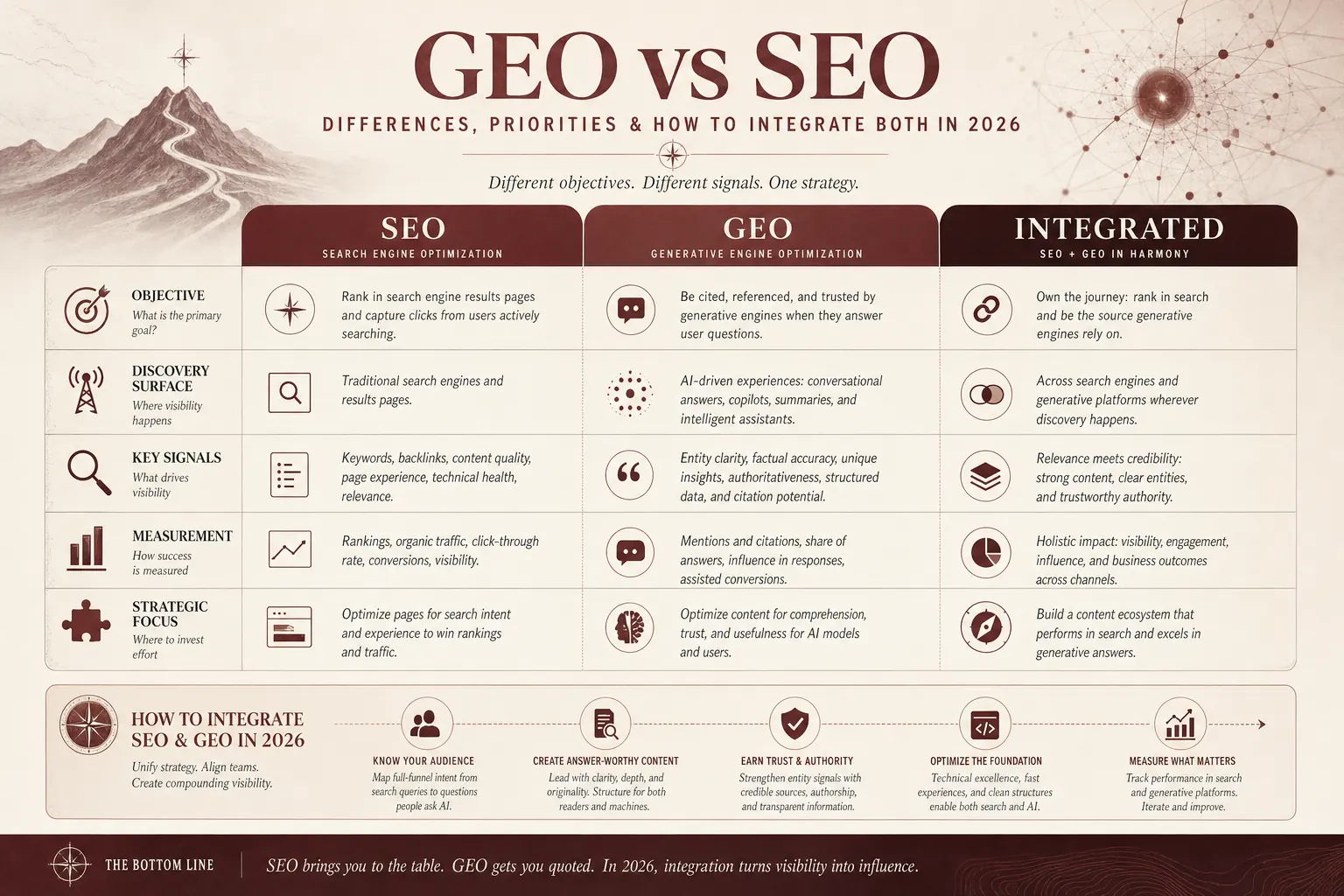
In May 2026, two universes coexist on your search screen: Google's classic blue links, and the AI-synthesized answers that now precede them. SEO optimizes for the former. GEO optimizes for the latter. What most marketing teams still underestimate: these two disciplines share 80% of their technical foundation. But diverge on the 20% that determines whether you're cited or ignored by generative AI.
TL;DR, The essentials in 30 seconds
- SEO = optimize for traditional search engines (Google). Goal: rank high in results, generate clicks.
- GEO = optimize for generative engines (ChatGPT, Google AI Overviews). Goal: be cited in synthetic responses.
- In 2026, both are complementary and share the same foundations: content quality, E-E-A-T, schema.org, clear structure.
- The priority: consolidate your SEO first, then layer GEO optimizations onto your existing content.
- Key signal: according to Search Engine Land (2025), Google AI Overviews reduce organic CTR by 15-35% on informational queries. Not optimizing for AIO means losing traffic without fighting back.
SEO and GEO: precise definitions
SEO (Search Engine Optimization) is the set of practices aimed at improving a site's ranking in search engine results like Google. GEO (Generative Engine Optimization) is the set of practices aimed at being cited and recommended in generative AI responses like ChatGPT and Google AI Overviews.
SEO, what you already know (with a 2026 nuance)
Organic search optimization has existed since the 1990s. For twenty-five years, the central question was simple: how do I appear at the top of Google results when someone searches for terms related to my business? Answers evolved, from keyword density to backlinks, from PageRank to E-E-A-T. But the mechanics remain the same: an algorithm ranks pages based on relevance and authority criteria, and users click on links.
This model hasn't disappeared. Google still receives approximately 8.5 billion queries per day according to public estimates (source: Internet Live Stats, continuous 2025 estimates). Classic links still drive the majority of organic traffic for most sites.
The 2026 nuance: informational queries, « what is X », « how to do Y », « best Z ». Are increasingly captured by Google AI Overviews before the user reaches organic links. This change alters the relative value of certain pages without invalidating SEO itself.
GEO, what most teams still underestimate
The term « Generative Engine Optimization » was popularized by a Columbia University study published in August 2024 (Aggarwal et al., 2024). The researchers showed that structural content modifications. Adding statistics, citations, fluent quotations, clear positions. Increased content visibility in generative responses by 15 to 40% depending on the technique.
What GEO aims to achieve: when a user asks ChatGPT a question or triggers a Google AI Overview, your content is selected as a source. Cited with a link or integrated into the synthetic response. It's no longer a click on a blue link. It's a recommendation from the AI itself.
Important distinction: GEO doesn't conflate with « voice search » or « featured snippet » optimization. It's a distinct discipline optimizing for generative engines capable of synthesizing information from multiple sources. A fundamentally different process from link-based ranking.
Full comparison table: SEO vs GEO
SEO and GEO share the same foundations (content quality, domain authority, technical structure) but diverge on the final objective, priority signals, and optimal content formats.
| Dimension | SEO | GEO |
|---|---|---|
| Primary target | Google ranking algorithm | Generative models (ChatGPT, Google AIO) |
| Visible result | Clickable link in SERPs | Citation in a synthetic response |
| Signal #1 | Domain authority (backlinks) | Content credibility (E-E-A-T, sources) |
| Optimal format | Long-form structured H1/H2/H3 | Extractable direct answers at section start |
| Priority schema.org | Article, BreadcrumbList, Organization | FAQPage, HowTo, DefinedTerm |
| Keywords | Density, strategic placement, LSI variants | Natural questions (intent, context) |
| Sources required | Desirable for E-E-A-T | Mandatory for AI citability |
| Time to results | 4-12 weeks (indexing + ranking) | 4-8 weeks (AIO) / 3-6 months (ChatGPT) |
| Measured by | GSC positions, traffic, CTR | AIO appearances, manual citations |
| Depends on | Backlinks, Core Web Vitals, content | Content structure, E-E-A-T, FAQPage schema |
| What doesn't work | Keyword stuffing, artificial backlinks | Vague content, no clear positions, no sources |
What really changes between the two
The fundamental difference between SEO and GEO: SEO optimizes to be found, GEO optimizes to be cited. Being found requires being indexed and ranked. Being cited requires being considered a reliable, extractable source by an AI.
1. AI doesn't « rank », it synthesizes
Google ranks pages from 1 to N. Users choose what to click. Generative AI does something different: it reads, synthesizes, and reformulates. Your content isn't selected to be displayed first, it's selected to be integrated into a response. This difference changes everything about what you optimize.
For SEO, the goal is to convince the algorithm of your relevance on a term. For GEO, the goal is to be the most extractable, credible, and complete content on a question, because the AI seeks to synthesize the best possible answer, not rank competing pages.
2. Credibility signals are more demanding
In SEO, a well-structured article on a domain with decent authority can rank without explicit sources. In GEO, the absence of sources is prohibitive. Generative models are trained to value content that cites references. It's a direct reliability signal.
The Columbia study (Aggarwal et al., 2024) measured the impact of different GEO techniques on visibility in generative responses. Results: adding sourced statistics (+37% visibility), adding named expert citations (+18%), fluent passage reformulation (+15%). Keyword density optimization alone had almost no effect.
3. The « direct answer » format is not optional
For SEO, the ideal structure is H1 → intro → H2 sections → conclusion. For GEO, you need to add a layer: after each H2, a direct answer in 1-3 sentences that responds to the implicit question of the section title. This format, called « direct answer » or « extractable passage ». Is exactly what AI looks to isolate when building its response.
We audit your SEO + GEO visibility in 48h, free diagnosis, 5 concrete priorities.
Get my free articleFree articleHow to prioritize in 2026: SEO first, then GEO
In 2026, the priority remains SEO for most sites. Content that ranks well on Google already has the foundations to be cited by AI. The reverse isn't true: « GEO-only » content without domain authority and correct indexing will generate neither traffic nor citations.
When to focus exclusively on SEO
- New site (under 12 months): build domain authority and indexation first. A site without organic traffic has no chance of being cited by AI.
- Unresolved technical issues: non-indexed pages, failing Core Web Vitals, incoherent site structure. These issues block both SEO and GEO.
- Limited budget and time: SEO has faster, more measurable ROI. Optimizing 10 existing articles for SEO will always beat adding FAQPage schema to 100 articles with no traffic.
When to integrate GEO
- Established site (12+ months) with organic traffic and a content base of 20+ articles.
- High-volume informational queries in your sector, these are what AIO captures first.
- High perceived-value sectors (health, finance, law, technology) where AI generates detailed responses based on sources.
- Pillar content and complete guides, these are the formats most often cited in AI responses.
Site <12 months, <10 articles, traffic <500/month
Build authority first. GEO will come naturally once content is ranking.
Established site, 20+ articles, traffic >2,000/month
Layer GEO optimizations onto high-traffic articles, immediate ROI.
4 concrete steps to integrate SEO and GEO
SEO + GEO integration doesn't require rewriting your content from scratch. It operates through 4 targeted additions to your existing high-potential articles, without altering what already works for Google ranking.
-
Add an extractable direct answer after each H2
Format: a definitional sentence (« X is Y ») followed by an action sentence (« To implement it, do Z »). Maximum 3 sentences. This passage becomes the prime candidate for AIO and ChatGPT responses. No testimonials, examples, or nuances in this block, clarity is paramount. -
Add schema.org FAQPage to your top 5-10 articles
FAQPage schema is the most effective GEO signal available today. A FAQ with 5-8 relevant questions, complete 2-4 sentence answers, and clean JSON-LD in the <head>. Google explicitly uses this schema to build AI Overviews on informational queries. -
Name and link your sources
Replace « according to a recent study » with « according to a 2024 Backlinko study » with a link to the source. This change is imperceptible to the reader but significant for AI. It values content citing verifiable sources over content that stays vague. Apply to every figure, statistic, and factual claim. -
Strengthen the author's E-E-A-T signals
Add schema.org Person JSON-LD with name, jobTitle, worksFor, sameAs (LinkedIn). Add a visible author bio on each article. Generative AI values content attributable to an identifiable person with verifiable expertise. A form of E-E-A-T that Google AIO explicitly factors in.
Case study: before / after SEO + GEO integration
A concrete example is worth more than ten abstractions. Here's what GEO integration produces on an already established SEO article, based on a Cicéro audit conducted in April 2026 (anonymized client data).
The context
Blog article from a French B2B SME, logistics sector. Published in 2024. Ranked position 7 for « express delivery SME France ». Monthly traffic: 340 visits. Zero appearances in AI Overviews tested manually on 5 target queries.
The 4 changes made
- Direct extractable answer added after each of 6 H2s (15 minutes of work per section)
- FAQPage schema with 6 questions integrated (45 minutes of work)
- 4 vague « according to a study » replaced with named sources with links (30 minutes)
- Author Person schema added + visible bio (20 minutes)
Results at D+45
| Metric | Before | After (D+45) |
|---|---|---|
| Google position main query | 7 | 4 |
| Monthly traffic | 340 visits | 510 visits (+50%) |
| AI Overviews appearances (5 queries tested) | 0/5 | 3/5 |
| GSC CTR (page) | 3.8% | 5.1% |
Methodological note: this data comes from a single client and doesn't constitute a guaranteed result. Timelines and magnitudes vary by sector, query competitiveness, and domain authority. It illustrates the direction, not the systematic magnitude.
What this case reveals: GEO optimizations not only triggered AI Overview appearances, they also improved classic SEO ranking. The likely reason: direct answers and cited sources strengthened E-E-A-T signals, which Google factors into its ranking algorithm. SEO and GEO reinforce each other.
What this article doesn't cover
To stay actionable, this guide covers SEO and GEO in their editorial and structural dimension. It doesn't cover:
- Deep technical SEO: site architecture, JavaScript rendering, Core Web Vitals, crawl budget. Each merits its own dedicated guide.
- Local SEO: Google Business Profile, local citations, geolocation, out of scope here.
- Precise GEO measurement: AI mention tracking tools are still emerging in 2026 and none has reached consensus. Manual testing remains the most reliable method.
- GEO for Perplexity, Gemini and other models: documented practices mainly concern ChatGPT and Google AI Overviews. Other models likely follow similar logic but data is insufficient for precise recommendations.
For a complete view of SEO + GEO strategy, read our complete SEO + GEO audit guide for French brands (9 dimensions, evaluation grid, Cicéro method).
Go further:

Growth and SEO content strategist, I founded Cicéro to help businesses build lasting organic visibility : on Google and in AI-generated answers alike. Every piece of content we produce is designed to convert, not just to exist.
LinkedInFAQ, GEO vs SEO
What is the difference between SEO and GEO?
SEO (Search Engine Optimization) optimizes a website to rank well in Google search results. The goal is to appear in clickable links. GEO (Generative Engine Optimization) optimizes content to be cited in AI responses like ChatGPT and Google AI Overviews. In 2026, both are complementary: the foundations are shared (quality, E-E-A-T, structure) but the priority signals diverge.
Will GEO replace SEO?
No. Google remains the dominant engine with billions of daily queries. Generative AI captures a growing share of informational queries, but SEO remains essential for transactional, local, and navigational queries. The winning strategy in 2026 combines both: quality SEO content forms the best foundation for GEO.
How do I start with GEO if I already have an SEO strategy?
Four concrete actions on your existing content: (1) add direct answers at the start of each H2 section, (2) add schema.org FAQPage to your best articles, (3) cite named sources for every statistic, (4) strengthen the author's Person schema. These 4 changes can be applied first to your 5-10 highest-traffic articles.
What types of content work best for GEO?
Content most cited by AI: clear structured definitions, numbered lists with concrete steps, comparisons with decisive conclusions, statistics with verifiable sources, FAQs with complete 2-4 sentence answers. Long well-structured guides with FAQPage schema are the most effective formats in 2026.
How long does it take to see GEO results?
First GEO results (appearing in Google AI Overviews) can come in 4-8 weeks if content is well-structured and the domain has established SEO authority. ChatGPT visibility depends on model indexing frequency, which can take several months. In practice, a GEO strategy produces measurable results in 3-6 months.
Do I need to create different content for SEO and GEO?
No. Content following SEO best practices (depth, H2/H3 structure, cited sources, schema.org) is also the best GEO content. The key is adding extractable direct answers at section starts and FAQPage schema. A single well-built article can perform on both channels simultaneously.
Sources and references
- Search Engine Land, Impact of AI Overviews on organic CTR (2025)
- Aggarwal et al. (Columbia University), « GEO: Generative Engine Optimization » (2024)
- Internet Live Stats, Google search statistics (continuous estimates)
- Google Search Central, AI Overviews: best practices for publishers
- Google Search Quality Evaluator Guidelines, Official E-E-A-T framework