
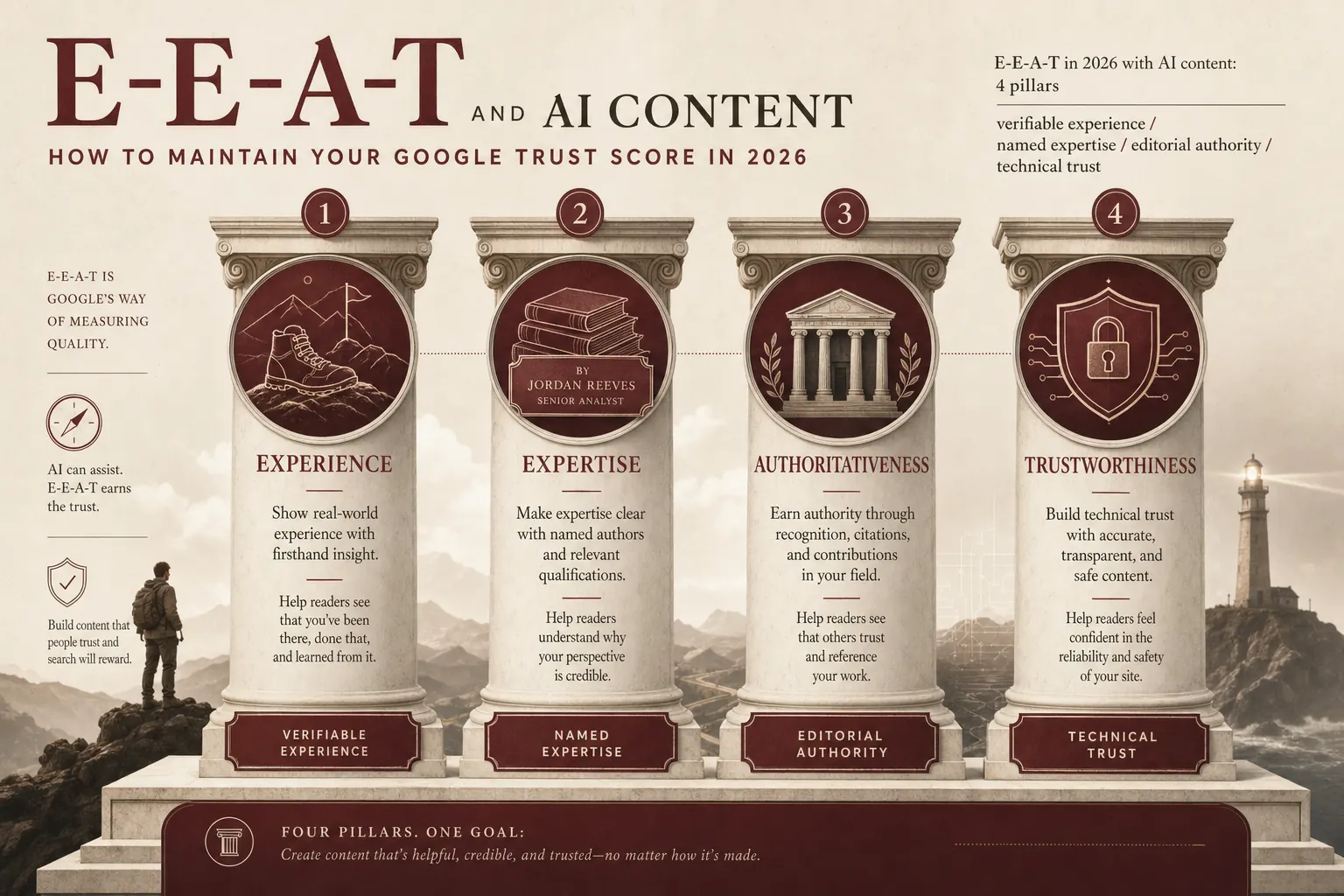
In May 2026, virtually all content teams and SEO agencies use AI tools to produce content at scale. The question is no longer « should we use AI? », that's settled. The question is: how do you produce AI content without eroding your site's trust score in Google's eyes?
The answer lies in the E-E-A-T framework. A set of criteria Google has documented since 2014 that has taken on decisive importance with the 2024-2025 Core Updates, precisely in the context of the proliferation of AI-generated content.
What exactly is E-E-A-T?
E-E-A-T stands for Experience, Expertise, Authoritativeness, Trustworthiness. This framework is documented in the Search Quality Rater Guidelines, the document Google publishes to guide its human evaluators in assessing page quality.
Has the author actually lived or practiced what they describe? Added in December 2022, this criterion distinguishes theoretical knowledge (having read about a topic) from concrete experience (having done, used, tested).
Does the author have recognized training or background in their field? Degrees, certifications, professional seniority, publications. Particularly critical for « YMYL » topics (health, finance, law).
Is the site or author recognized as a reference in their field by other players? Press mentions, academic citations, backlinks from authoritative sources, all verifiable authority signals.
Is the information sourced, verifiable, honest? Is the site transparent about its identity, authors, commercial interests? Trustworthiness is the most important criterion according to Google (Search Quality Rater Guidelines 2024, section 3.2).
What the 2024 Search Quality Rater Guidelines say
Google published a 2024 update of its Search Quality Rater Guidelines (public PDF, 172 pages). Several sections are directly relevant for teams producing AI content.
Section 4.4, « Lowest quality pages »
"Automatically generated content, or content that appears to be auto-generated or created by an AI system for the purpose of gaming search results."
The key is « for the purpose of gaming search results », intent matters. Using AI to produce quality content is not targeted by a low-quality signal. Producing AI content solely to position keywords without real added value is.
Section 3.2, « Most important E-E-A-T: Trust »
"The most important member of the E-E-A-T family is Trust. The other members of the E-E-A-T family contribute to Trust. [...] Low Trust is sufficient reason to give a page a low Page Quality rating."
Section 7.4, « Scaled content abuse »
"Creating many pages with the intent of having some pages rank for lots of keywords. [...] Using AI or automated tools to produce content at scale."
This signal is directly targeted by 2024 Core Updates. Sites producing 500-1000 AI articles per month on varied topics without identifiable expertise experienced documented traffic drops of 50-90% (source: analyses published by Search Engine Land and Lily Ray, SEO Consultant, 2024).
AI content: concrete E-E-A-T risks
| Risk | Mechanism | Documented examples |
|---|---|---|
| No identifiable author | Google cannot evaluate expertise or experience without knowing who wrote the content | Generic « blog » sites without author pages, missing bylines, absent schema.org Person |
| Vague or absent sources | Drop in Trust signal, Quality Raters flag unsourced content as unreliable | « Studies show that... » without citing the study, unattributed statistics |
| Coverage outside declared expertise | An SEO specialist site suddenly publishing medical or legal articles triggers a thematic incoherence signal | « All-terrain » AI-generated blogs covering health, finance, travel, tech in the same month |
| Abnormal publication volume | Going from 2 articles/month to 200 articles/month is a scaled content abuse signal | Cases documented by Glenn Gabe (SEO Consultant): sites losing 70-90% traffic after Sept. 2024 Core Update |
| No field experience in content | AI content cannot include original observations, mistakes made, field nuances. Unless supervised by an expert who adds them | « Complete guide » articles summarizing public sources without a proprietary angle |
Positive E-E-A-T signals Google can verify
1. Complete, verifiable author page
- Full name (not a generic pseudonym)
- A dedicated page describing background, areas of expertise, publications
- Link to a verifiable LinkedIn profile or professional site
- schema.org Person markup integrated in page code
2. Named sources in every article
- Study name + publishing institution + year
- Link to primary source (or secondary if primary is paywalled)
- Figures with clear attribution (« according to Statista, May 2025 » not « according to recent studies »)
3. Field experience signals in the body text
- Concrete results from applying the method
- Mistakes made and lessons learned
- Nuances only a practitioner would mention
- Screenshots, data, original examples
4. Structured schema.org
Minimum structure: @type: "Person" with name, jobTitle, url (LinkedIn or professional site), sameAs + @type: "Article" with author, publisher, datePublished.
Before / after: weak AI content vs AI content with strong E-E-A-T
Weak E-E-A-T version
"Recent studies show that SEO remains an essential lever for businesses. It is important to optimize your meta descriptions, create quality content and obtain backlinks. According to experts, 2026 trends include AI and voice search..."
Strong E-E-A-T version
"Across the 12 client sites Cicéro supported in 2025, those that integrated FAQPage markup + quarterly pillar updates progressed on average +34% in GSC impressions over 6 months. Here is the method we apply, with the obstacles we encountered..."
E-E-A-T checklist for your next publication
- Identified author: full name + verifiable professional profile link (LinkedIn minimum)
- Dedicated author page: biography + area of expertise + publications or references
- schema.org Person: JSON-LD markup integrated in the page with url and sameAs
- At least 3 named sources: every figure, every key claim = institution + year
- At least 1 field observation: real result, example drawn from practice, practitioner nuance
- Thematic consistency: the article is within the site's declared expertise scope
- Reasonable publication cadence: no sudden multiplication by 10x of volume
- « Limits / what's not covered » section: signals editorial honesty and rigor
- Visible publication and update dates: sign of freshness and maintenance
- Complete About page: transparency on who publishes, why, with what interests
Cicéro audits your existing content and identifies priority E-E-A-T adjustments to maintain and improve your positions.
Get my free articleFree articleE-E-A-T and GEO: being cited by generative AIs
A frequently overlooked point: the E-E-A-T signals that satisfy Google also benefit your visibility in generative AIs like ChatGPT and Google AI Overviews.
ChatGPT (via its integrated search engine) and Google AI Overviews favor sources that are: cited by other authoritative sources, have verifiable and sourced data, are associated with identifiable authors or organizations, and are structured for machine reading (schema.org, numbered lists, direct definitions).
In other words, content strong in E-E-A-T is structurally a better candidate for citation by generative AIs. This is not coincidental, AIs are trained on the same quality signals Google has been evaluating for a decade.
To go further: The article How to appear in ChatGPT and Google AI Overviews details the 7 steps to optimize your content's citability by generative AIs.
What this article doesn't cover
Scope and limits
- This article covers E-E-A-T in the context of AI content. Not E-E-A-T for YMYL sites (health, finance, law) which have distinct and stricter requirements.
- It doesn't cover third-party E-E-A-T scoring tools. These scores are not certified by Google and their predictive value is limited.
- It doesn't cover schema.org author markup in detail. This topic will merit a dedicated article.
- Core Update data cited is based on public reports from SEO analysts (Search Engine Land, Lily Ray, Glenn Gabe). Not on direct Google data, which is unpublished.
Frequently asked questions about E-E-A-T and AI content
What is E-E-A-T in SEO?
E-E-A-T stands for Experience, Expertise, Authoritativeness, Trustworthiness. It's Google's quality evaluation framework documented in the Search Quality Rater Guidelines. The second "E" (Experience) was added in December 2022 to distinguish theoretical expertise from real experience.
Does AI-generated content penalize SEO?
AI-generated content is not penalized per se by Google. What is evaluated is the E-E-A-T quality of the content. Regardless of who or what produced it. AI content without identifiable human expertise will have a low E-E-A-T score. AI content supervised by an identifiable expert, sourced and enriched with field experience can have a high score.
Which E-E-A-T signals does Google actually verify?
Verifiable E-E-A-T signals include: author page with verifiable information, external mentions in recognized sector publications, citations in authoritative sites, structured Person/Organization schema.org markup, consistency between topics covered and declared expertise, and named sources within content.
How to improve E-E-A-T with AI-generated content?
To maintain high E-E-A-T with AI content: (1) associate each article with an identifiable human author with a complete author page, (2) enrich generated content with field observations, (3) cite named sources, (4) don't cover topics outside declared expertise, (5) structure author data as schema.org Person, (6) obtain mentions in recognized external publications.
Is E-E-A-T a direct ranking factor?
Google has officially stated that E-E-A-T is not a « ranking factor » in the sense of a single algorithmic signal. However, the signals that allow Google to evaluate E-E-A-T are real ranking signals. E-E-A-T is an evaluation framework, not a score. But its components indirectly constitute the most durable signals in SEO.
Sources and references
- Google, Search Quality Rater Guidelines 2024 (public PDF, 172 pages)
- Google Search Central Blog, « Helpful content system » updates (2022-2024)
- Search Engine Land, March 2024 Core Update analyses, coverage by Barry Schwartz
- Lily Ray (SEO Consultant), « HCU Winners and Losers » analyses (2024, published on Amsive Digital)
- Glenn Gabe (SEO Consultant), September 2024 Core Update case studies (published on G-Squared Interactive)
- Google December 2022, Announcement of « Experience » addition to E-A-T framework

SEO and GEO strategy consultant for French brands. I run Cicéro, an agency specializing in organic visibility on Google, ChatGPT and AI generative engines. The E-E-A-T question in an AI production context is at the heart of our daily work at Cicéro.
View LinkedIn profile