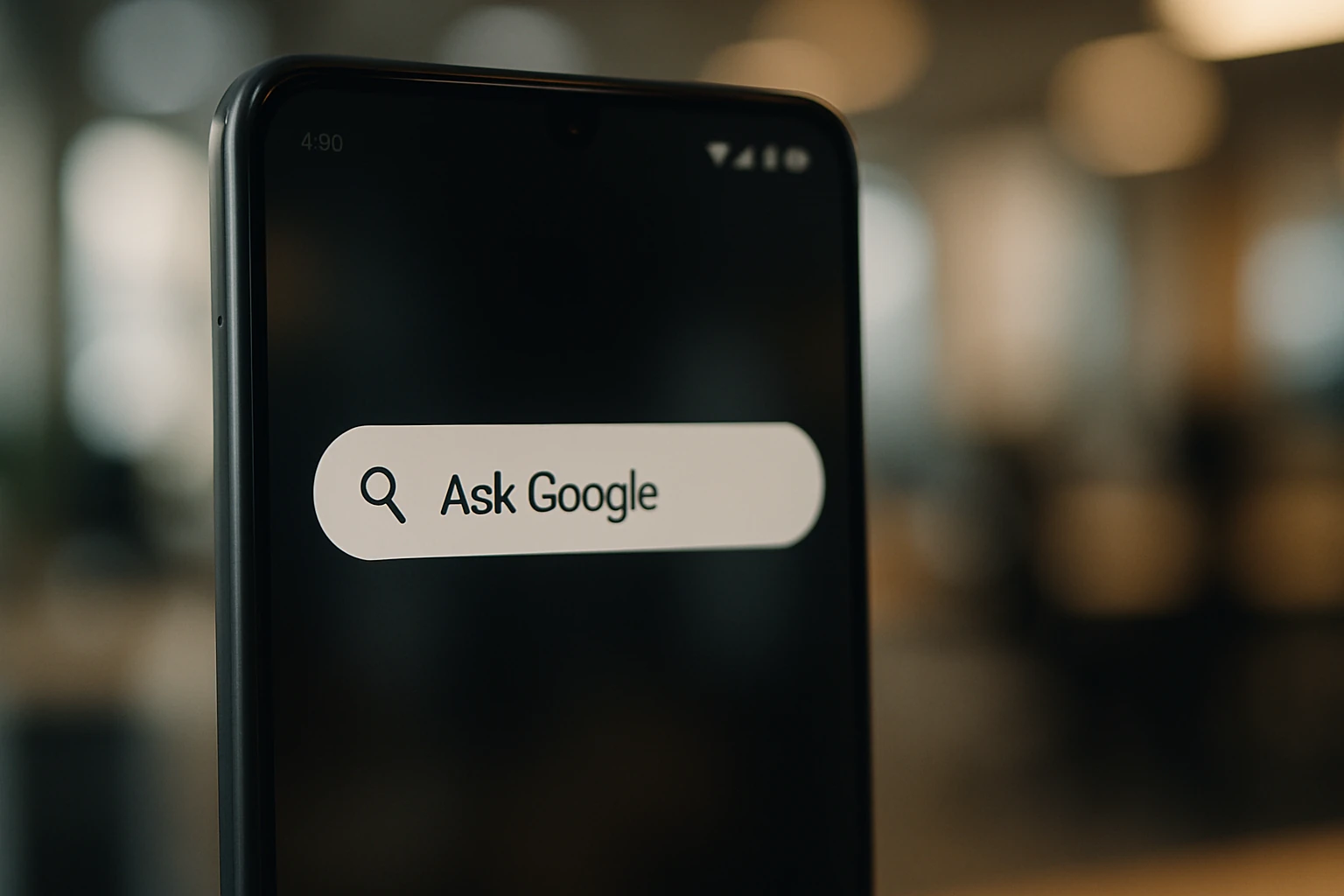
The April 29 announcement: what changed on Android
On April 29, 2026, Google deployed a quiet but symbolic update via version beta 17.18 of its Android app. The search bar lost its long-standing « Search… » text prompt and now displays « Ask Google » instead.
This is not just a cosmetic change. The Google "G" logo disappeared, replaced by a "+" menu that lets users directly add an image to their query, switch to conversational AI Mode, or generate images. The change applies across the Pixel Launcher, the Google app on Android and iOS, and the Chrome address bar on both desktop and mobile.
Source: 9to5Google, April 29, 2026.
The signal is clear: Google is no longer asking you to « search ». It is inviting you to « ask. » Conversational search powered by Gemini is no longer an option buried in a menu. It is the default entry point for hundreds of millions of Android users worldwide.
What this means in practice: An Android user typing a question into Google now arrives in an AI-first interface by default. Blue links are no longer the first thing they see.
75M users, 1 billion queries: the AI Mode numbers
These interface changes reflect massive adoption. Nick Fox, Google's Vice President of Search, confirmed that Google AI Mode has reached 75 million daily active users and now processes over one billion queries per month in the US and India alone.
AI Mode works on a query fan-out principle: Gemini runs multiple parallel searches, analyzes sources, and synthesizes a unified response directly in the interface. Users no longer need to go find the information, it comes to them.
This adoption, combined with AI Mode's integration into Android's primary search interface, means that businesses' mobile audiences are shifting to a fundamentally different search behavior. Often without it showing up visibly in their Google Analytics dashboards.
Is your content optimized to be cited by AI Mode? A free GEO audit gives you the answer within 24 hours.
93% zero-click: the new SEO reality
AI Mode's adoption has a direct consequence on web traffic. According to a Seer Interactive study published in early 2026, 93% of queries processed by AI Mode end without any click to an external website. Users get their answer and leave, without visiting any source.
SERP analysis data confirms the trend across classic queries with AI Overviews:
| Query type | CTR impact | What it means |
|---|---|---|
| Simple informational | −61% | Definitions, « how does X work », basic how-tos |
| Complex informational | −46.7% | In-depth guides, multi-step analysis |
| Commercial / comparison | −15% | « Best X for Y », product comparisons |
| Branded queries | +18% | Known brands capture more direct clicks |
Source: SERP analysis (Dataslayer.ai, 2026) and Seer Interactive study.
Healthcare is the most impacted sector: 88% of medical queries now trigger an AI Overview. Education (83%) and B2B tech (82%) follow closely. For businesses in these sectors, the model of « produce informational content and attract search traffic » is structurally broken.
Related reading: our guide on how to appear in ChatGPT and Google AI Overviews, published May 3, 2026.
The hidden opportunity: cited sites convert 5x better
The critical nuance that most reports miss: zero-click does not impact all sites equally. Sites that are cited in AI responses, rather than simply ranked, perform very differently.
SERP analysis data shows that:
- Sites cited in AI Overviews receive 35% more clicks compared to non-cited top-10 organic results
- The conversion rate of this traffic reaches 14.2% vs 2.8% for classic organic traffic
- Ads now appear in 25.5% of SERPs with AI Overview, up 394% year-over-year (Source: Digital Applied, 2026)
The message is clear: the click battle is lost. The citation battle is just beginning.
This is exactly the principle of GEO (Generative Engine Optimization), structuring content so that a large language model can cite it with confidence, not just rank it.
3 levers to adapt your strategy now
1. Shift from informational content to citable content
AI responses cite sources that:
- Provide a direct answer in the first 100 words (passage indexing)
- Reference named, verifiable data (not « studies show » but « a Seer Interactive study from January 2026 shows »)
- Use structured Article, FAQ, and HowTo schemas to signal content structure
- Are associated with an identified author with verifiable expertise (E-E-A-T)
2. Invest in branded and commercial queries
These two query types resist zero-click much better. Branded queries actually see +18% CTR growth. Building brand recognition, through thought leadership content, press mentions, customer reviews. Becomes a direct SEO lever, not just a marketing goal.
Our analysis of Google AI agents and their impact on website accessibility covers a complementary dimension of this evolution.
3. Structure content for « query fan-out »
AI Mode analyzes multiple queries in parallel before synthesizing. To be cited, your content needs to answer several related questions on the same topic, not just the main query. An article that covers a niche exhaustively (with FAQ, examples, data, nuances) has far better chances of being summoned as a source.
This is the same logic as semantic content hubs. But applied to AI responses, not just crawlers. See how Google AI Max is reshaping the SEO/paid search boundary for additional context.
Is your site visible in Google AI Mode? Our SEO GEO audit guide shows you exactly what to check.
What this article does not cover
Scope and limitations:
- The CTR figures cited (−61%, −46.7%) come from SERP analyses on the US market. The exact impact on European or French markets may vary. AI Mode is being deployed progressively and adoption levels differ by region.
- This article does not address the impact on paid search (Google Ads in AI Mode) or AI Mode-specific SEA strategies. That topic is covered in our analysis of Google AI Max and the SEO/paid boundary.
- Conversion rates (14.2% vs 2.8%) are cross-sector averages. They may vary significantly depending on your industry and audience.
FAQ, Your questions on Google AI Mode and SEO
Google AI Mode is a conversational search mode powered by Gemini that replaces ranked link lists with synthesized AI-generated answers. It uses a « query fan-out » technique. Gemini runs multiple parallel searches, analyzes sources, and generates a consolidated response directly in the interface. Since April 29, 2026, it is accessible directly from the « Ask Google » bar on Android (previously labeled « Search »).
According to a Seer Interactive study, 93% of queries processed by Google AI Mode end without any click to an external website. AI Mode generates a complete answer directly in the SERP. Users get what they need without leaving Google. This is the logical endpoint of Featured Snippets and AI Overviews: the answer lives in the results page, not in the sites that compose it.
Branded queries actually see a +18% CTR increase. Commercial and comparison queries only drop by 15%. Simple informational queries fall 61%, complex informational queries 46.7%. The strategy: migrate content toward commercial, branded, or citable formats (to appear in AI citations that convert at 14.2%).
To be cited: provide direct answers in the first 100 words, name your data sources explicitly, implement Article and FAQ structured data schemas, associate content with an identified expert author (E-E-A-T), and cover topics exhaustively to match AI Mode's query fan-out. Sites cited in AI Overviews generate 35% more clicks and convert at 14.2% vs 2.8% for classic organic.
Google deployed an update (Google app beta 17.18) replacing « Search... » with « Ask Google ». The Google "G« logo was replaced by a »+" menu with three options: add an image from Gallery or Camera, switch to AI Mode, or generate images. This applies across the Pixel Launcher, Google app on Android and iOS, and Chrome desktop/mobile. Source: 9to5Google, April 29, 2026.

Growth strategist and SEO & GEO content expert, I founded Cicéro to help businesses build durable organic visibility. On Google and in AI responses. Every piece of content we produce is designed to convert, not just exist.
LinkedIn