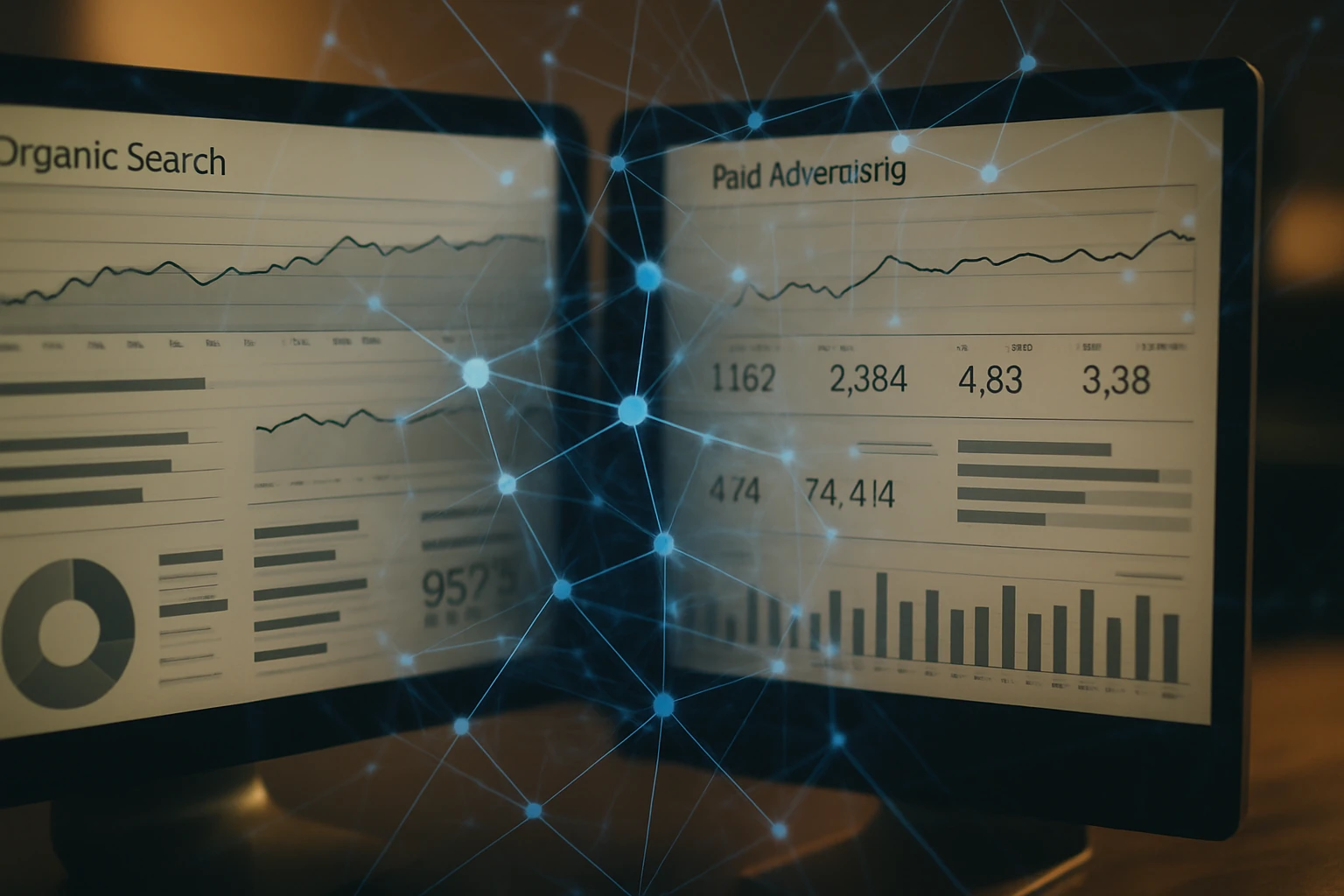
On April 30, 2026, Google celebrated the first anniversary of AI Max for Search campaigns with four major feature announcements. In one year, AI Max became Google Ads' fastest-growing AI-powered advertising product. And its new capabilities will directly affect the SEO ecosystem, particularly on conversational and long-tail queries.
Primary source: Google Ads official blog « AI Max Turns 1 with new ways to steer performance » (April 30, 2026, Brandon Ervin, Director of Product Management, Google Ads).
What is Google AI Max?
Launched in 2025, AI Max is an optimization mode for Google Ads Search campaigns. It automates three layers that were previously manual:
- Targeting, AI Max interprets real-time search intent, even on queries outside your keyword list.
- Ad creative, it dynamically generates and optimizes ad assets.
- Landing page, via Final URL Expansion, it can route users to the most relevant page on your site, not necessarily the one you specified.
That third point is where the SEO implications are sharpest: Google's AI decides which of your pages deserves the traffic. A mechanism that mirrors what the organic algorithm does, but on the paid side.
The 4 new features announced April 30, 2026
1. AI Max for Shopping
This is the most structurally significant expansion. AI Max now integrates Shopping campaigns: it reads your Merchant Center feeds and transforms product data into dynamic Shopping ads capable of answering conversational queries, the type that standard Shopping campaigns couldn't capture (« which wireless headphones are best for an 8-year-old who plays sports? »).
Google notes this feature is also coming to Performance Max. The upgrade is presented as a « one-click » migration for existing campaigns.
For e-commerce SEOs: AI Max for Shopping will generate competing paid ads on the long-tail queries you were targeting organically with buying guides and comparison articles.
2. AI Max for Travel
Until now, Travel advertisers had to manage multiple fragmented campaign types (hotels, flights, packages) across different interfaces. AI Max for Travel consolidates them in one place using your travel feeds as the foundation.
Direct consequence for Travel SEO: traffic on queries like « cheap flights Paris-Barcelona » or « 4-star hotel Lisbon » will face increasing competition from ultra-relevant, personalized AI-powered ads.
3. AI Brief, guide Google's AI with your brand voice
This is the most editorially innovative feature. Powered by Gemini, AI Brief allows advertisers to instruct Google's AI in plain language:
- Messaging Guidelines, define what your ads should and shouldn't say. Example: « never mention prices, » « always highlight free shipping. »
- Matching Guidelines, set boundaries for queries to target or avoid. Example: « prioritize searches for organic products, » « exclude B2B queries. »
- Audience Guidelines, deliver tailored messages to specific segments. Example: « for health-conscious users, highlight our clean-ingredient products. »
AI Brief generates asset and query previews before you commit. You can iterate before locking in. Rolling out in English first for AI Max Search campaigns, then Performance Max and AI Max for Shopping.
SEO angle on AI Brief: This is the same challenge as GEO/AI Search optimization. Teaching an AI to represent your brand accurately. If you're already working on your positioning for AI Overviews, you have a head start on AI Brief.
Is your content optimized to hold its ground against AI Max on your target queries? We analyze your visibility for free.
Free article4. Text disclaimers for Final URL Expansion
Final URL Expansion (FUE) was previously incompatible with industries that require mandatory legal copy (finance, healthcare, insurance). Google removes this barrier: text disclaimers will allow regulated-industry advertisers to use FUE while guaranteeing required legal text always appears in their ads.
For SEOs in regulated sectors: expect increased paid competition on your queries, particularly from advertisers who previously self-excluded from FUE due to compliance concerns.
What this concretely changes for your SEO
These 4 features share a common denominator: they make paid ads more relevant, more personalized, and better at capturing conversational long-tail queries. Precisely the queries where content SEO had been least disrupted by paid competition.
3 direct implications for your SEO strategy:
- Audit your landing pages, Final URL Expansion routes paid traffic to the most relevant page. If your blog posts and guides are well-structured, the algorithm may select them. Optimize them to convert, not just inform.
- Double down on non-replicable expert content, AI Max excels on transactional and short conversational queries. Your organic advantage lies in deep expertise content: case studies, proprietary data, sector analysis. These can't be replicated by an AI ad.
- Monitor your e-commerce informational queries, « how to choose X » and « Y vs Z comparison » guides face direct competition from AI Max Shopping on pre-purchase queries. The response: go deeper on expertise, not just higher in volume.
Our take: the SEO/PPC convergence is accelerating
What strikes me most about this announcement is the AI Brief. For the first time, Google is giving advertisers a tool to instruct its AI in plain language, exactly what SEOs and GEO specialists are already doing with content to get well-represented in AI-generated answers.
The boundary between « SEO » and « PPC » is transforming into « how to effectively instruct Google's various AIs ». Whether that's the organic algorithm, AI Overviews, or Google Ads AI. The skill sets are converging.
This isn't a threat to SEO. It's an opportunity for those who understand both sides and can build a coherent content strategy that feeds both organic visibility and paid performance. That's precisely what we do at Cicero: content that converts in an increasingly AI-driven Google ecosystem.
⚠️ Limits of this article
- This article does not cover the implications for Performance Max campaigns (separate analysis needed).
- AI Brief features launch in English only. Availability in other languages has not been dated by Google.
- We do not have access to internal advertiser performance data for AI Max (data not published by Google).
- The actual impact on organic SERPs depends on AI Max adoption rates in your specific sector, measure case by case.
Frequently asked questions
Google AI Max is an AI-powered mode for Search campaigns in Google Ads, launched in 2025. It automatically optimizes bids, targeting, creative, and landing pages based on real-time search intent. After one year, it's Google Ads' fastest-growing AI product, now expanding to Shopping and Travel campaigns.
Indirectly, yes, especially on conversational and long-tail e-commerce/travel queries. AI Max makes paid ads more relevant on queries that previously had weak ad competition, reducing your organic differential advantage. Counter-strategy: build non-replicable expert content that AI ads can't replace.
AI Brief is a Gemini-powered tool inside AI Max that lets advertisers guide Google's AI using plain language instructions: messaging guidelines, matching guidelines, and audience guidelines. It generates previews before commitment. Rolling out in English first, then expanding to other languages and Performance Max.
Three actions: (1) Audit landing pages for conversational relevance. FUE may route paid traffic to your blog posts, so optimize them to convert. (2) Strengthen non-replicable expert content on informational queries. (3) For e-commerce and travel, anticipate increased paid competition and invest in deeper comparison guides and proprietary data content.

Growth and SEO & GEO content strategy specialist, I founded Cicéro to help businesses capture lasting organic visibility. On Google and in AI-generated answers. Every piece of content we produce is designed to convert, not just exist.
LinkedIn