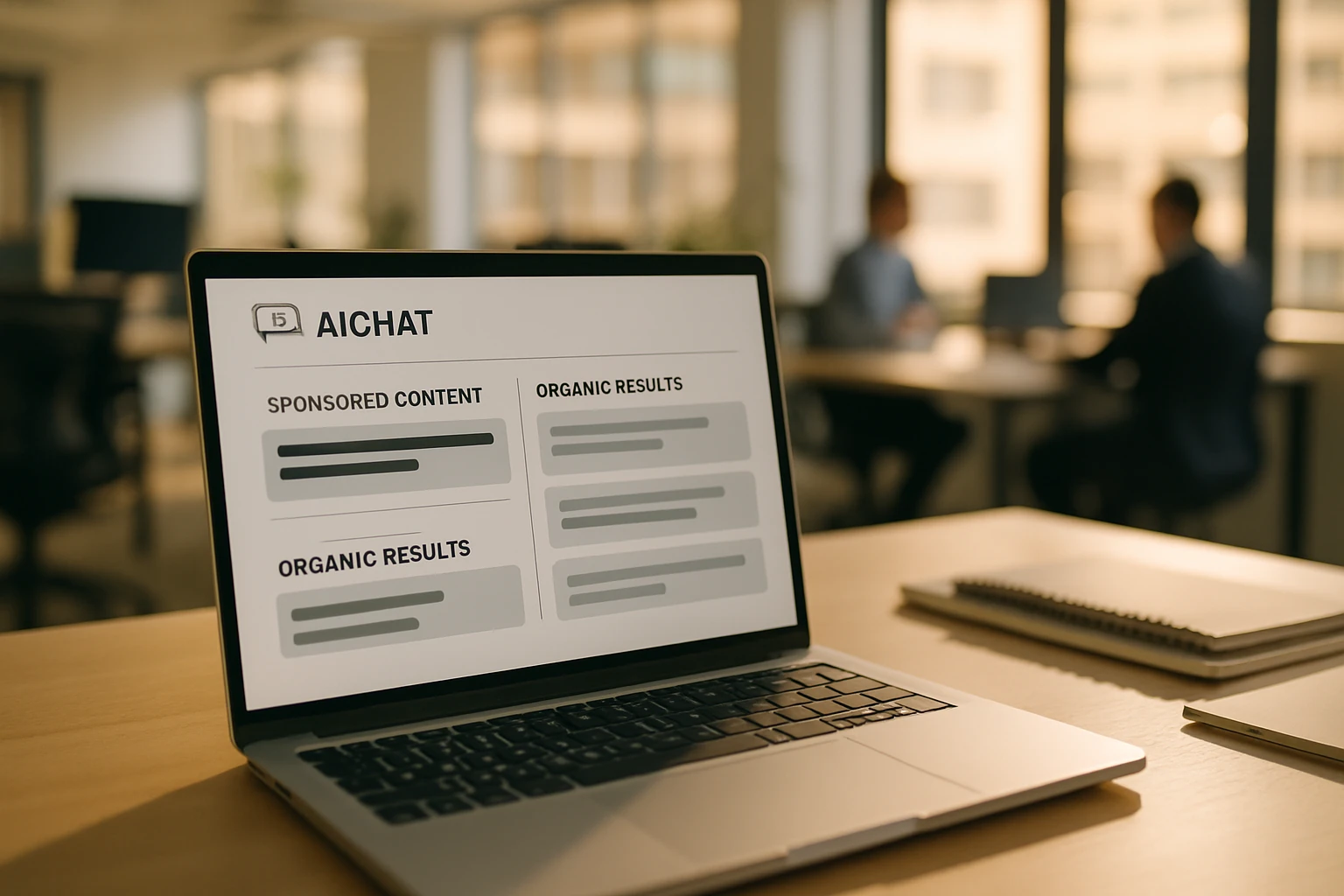
On May 5, 2026, OpenAI opened its ChatGPT Ads Manager self-serve beta to all US advertisers, allowing brands to create and manage campaigns appearing directly within ChatGPT responses, no managed partner required, according to Axios reporting on May 5, 2026. The $50,000 pilot minimum is gone. Any advertiser with a US account can now buy space inside AI answers.
That's the structural shift: for the first time, paid content sits alongside organically cited content within ChatGPT responses. This doesn't just affect advertisers: it changes the calculus for every brand investing in AI search visibility and generative engine optimization.
Is your content getting cited in ChatGPT without paying? That's exactly what GEO measures, and what's at stake.
What OpenAI actually launched
The ChatGPT Ads Manager offers two buying models: traditional CPM and now CPC bidding, the latter letting advertisers pay per click rather than per thousand impressions. Conversion tracking is available through a Conversions API and pixel integration. Reporting is aggregated. Partners including Dentsu, Omnicom, Publicis, WPP, Adobe, Criteo, Kargo, Pacvue and StackAdapt are already integrated.
This is not a test anymore. It is production infrastructure with major agency and ad-tech integrations. The ChatGPT ad ecosystem is live.
The Anthropic counterpoint: Claude stays ad-free by design
One day before OpenAI's announcement, on May 4, 2026, Anthropic confirmed that Claude will never display advertising. The stated reasoning: "advertising incentives are incompatible with a genuinely helpful AI assistant." This is an explicit rejection of the OpenAI model.
This divergence creates a concrete reality for your AI content optimization strategy: in ChatGPT, your organic citations coexist with paid placements. In Claude, there are no ads: only content quality determines who gets cited.
Three concrete impacts on your GEO strategy
The question isn't whether ads will dominate ChatGPT responses over time: they will. The question is: when the best positions inside ChatGPT are purchased, how does your organic content hold its ground?
- The bar for citable content rises. When an advertiser can pay to appear in a response, the organically cited content must be demonstrably more reliable and substantive to justify its presence. Shallow content gets outbid or displaced. Depth, named sources, and proprietary data become competitive moats.
- Platform diversification becomes urgent. Perplexity, Claude, and Gemini don't (yet) run ads at ChatGPT's scale. Organic reach there is cleaner. Concentrating your entire GEO investment on ChatGPT alone is a strategic error in 2026.
- E-E-A-T signals become defensive capital. Named author, cited sources, dated data, documented field expertise: these differentiate your content from a paid generic response. An anonymous AI-generated article has no competitive edge against well-structured expert content with clear attribution.
What to do in the next two weeks
Paid AI advertising is added pressure, not a death sentence. Brands that built solid GEO before May 2026 keep their organic advantage: their content gets cited even when competitors buy visibility. Two concrete actions: audit your current unpaid presence in ChatGPT responses (are you being cited without paying?), and strengthen your highest-traffic pieces with proprietary data and named sources that AI systems can confidently cite.
Our take
OpenAI chose Google's playbook: monetize attention, even if it blurs the line between what's paid and what's earned. It's commercially viable and a long-term trust problem. For brands, the signal is clear: free visibility inside AI systems has an expiration date. Those building authority now, through citable, structured, signed content, will be best positioned when the organic space contracts.
Sources
- → Axios: OpenAI launches self-serve ad platform (May 5, 2026)
- → Search Engine Journal: OpenAI Launches Self-Serve Ads Manager for ChatGPT (May 5, 2026)
- → Anthropic Newsroom: confirmation that Claude will remain ad-free (May 4, 2026)
Growth and SEO content strategist, I founded Cicéro to help businesses build lasting organic visibility, on Google and in AI-generated answers alike. Every piece of content we produce is designed to convert, not just to exist.
LinkedIn