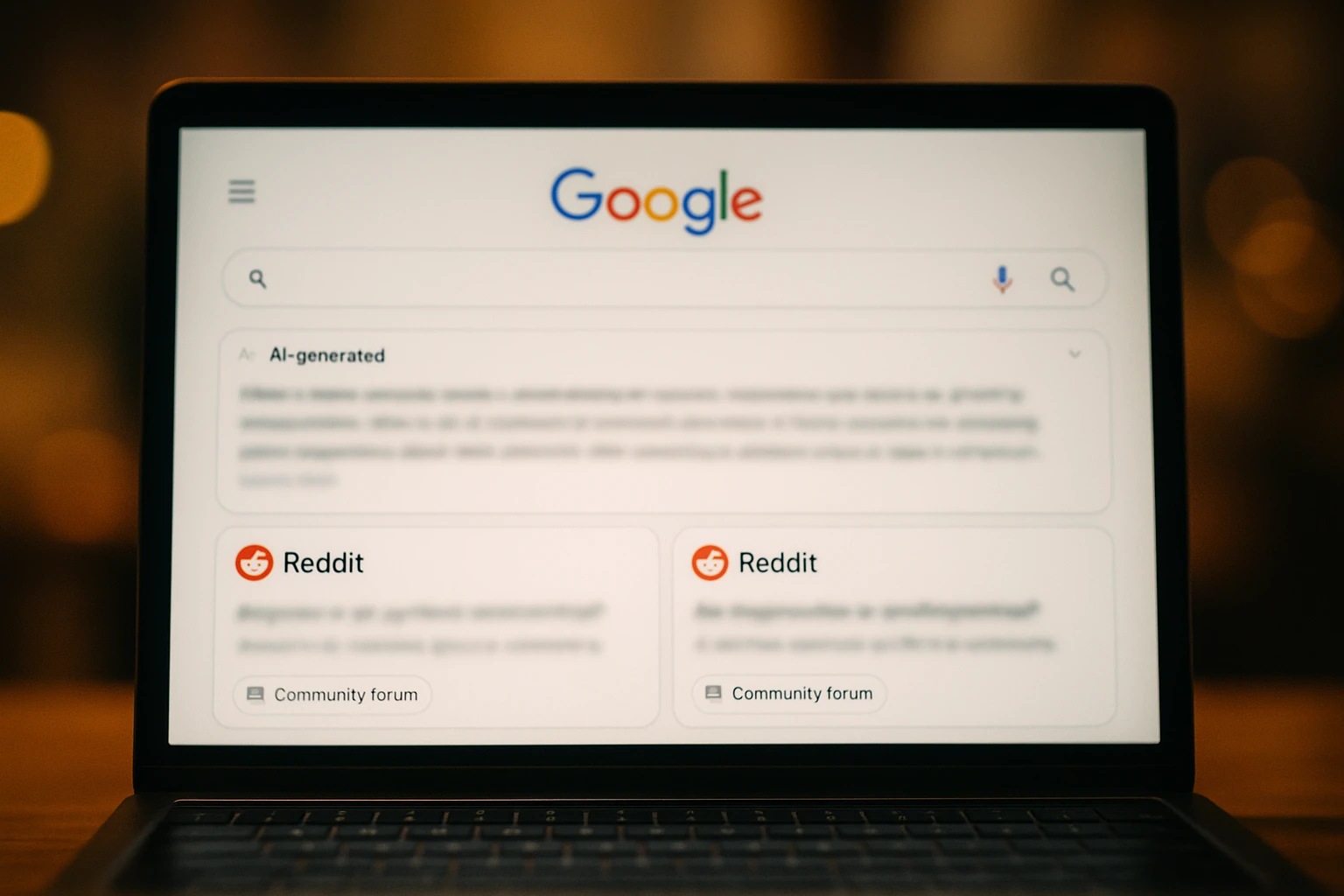
On May 6, 2026, Google announced 5 new ways to enrich its AI-powered Search responses, according to an official post on the Google Blog authored by Hema Budaraju, VP of Product Management for Search. The most significant change for content creators: Reddit discussions, expert forums, and news subscriptions are now cited with direct author attribution inside AI Overviews and AI Mode.
This isn't a traditional algorithm update. It's a doctrine shift: Google officially recognizes that authentic voices on the web, practitioners, niche experts, communities. Carry equal weight to brand-published articles in its AI responses. For SMBs and content creators, the rules of visibility have changed.
Context: These announcements come as AI Overviews have already cut average organic traffic by 42%. Google is trying to rebuild trust. From both users who question AI answers, and publishers who question the AI ecosystem.
The 5 New Features, Decoded
Here's exactly what Google is rolling out, and what each change means for your visibility strategy:
1. Suggested exploration angles. AI responses now link to articles covering specific angles of a topic. Not just the most popular pages, but the most in-depth analyses of distinct facets. A site that covers a subject with original depth becomes more visible than a site publishing generic overviews.
2. News subscription highlights. Links from the user's own news subscriptions are now prominently featured in AI responses. Google reports that in testing, users were « significantly more likely to click links labeled as their subscriptions. » For publishers with paid models, this is a direct signal.
3. Community perspectives with creator attribution. When Google cites a Reddit discussion, forum thread, or social post, it now displays the author's name, handle, and community name. The stated goal: help users identify trustworthy firsthand sources. The practical consequence: your active presence in industry communities is now a direct GEO signal.
4. Inline contextual links. More links now appear directly within the body of AI responses, adjacent to relevant text. Not just stacked at the bottom. Well-structured, citable content (factual, precise, scannable) gets embedded into the reading flow.
5. Website preview tooltips on hover. Desktop users can hover over inline links to see the site name and page title before clicking. Recognizable brands with clear editorial positioning benefit the most: your domain name and page titles are now conversion levers, not just SEO signals.
What This Actually Changes for Your Visibility
Before this update, appearing in an AI Overview primarily required well-structured, well-indexed content. That's still necessary, but no longer sufficient. Google is widening its sources toward social trust signals: communities that discuss your brand, experts who reference your work, threads where your analyses are cited.
This accelerates a trend already visible in Google's AI Mode, which processes queries like a researcher, not a keyword engine. It synthesizes, cites, and weighs sources. Being visible in this paradigm means being cited, not just crawled.
For businesses, the direct implications are:
- Reddit and professional forum presence, participating in your sector's online discussions is no longer optional if you want AI Overview citations. Authentic engagement, not link drops.
- Deep niche content, Google is looking for original angles, not paraphrased summaries. A 500-word article on a specific sub-topic beats a generic 3,000-word guide.
- Brand authority, if your domain name means nothing to users, the hover preview won't convert them, even if Google cites you. Building a recognizable brand in your niche is now a direct SEO lever.
What to Do Right Now
These 5 features aren't fully deployed yet, Google indicates a gradual rollout. But the signals they'll measure are already active. Here are concrete actions to take today:
Map your community presence. Are there Reddit threads, specialized forums, or LinkedIn groups where your industry is active? If so, are you present authentically, not just posting links? This is where future AI citations will originate.
Structure content for citability. AI responses look for precise, factual passages. Content with clear definitions, sourced data, and structured lists is more citable than flowing prose. Adapt your formats accordingly, this is especially critical as Google accelerates deindexing of generic AI-generated content.
Sharpen your editorial positioning. The hover preview shows your domain and page title. If neither means anything to the user, they won't click, even with a Google citation. Define a clear, consistent editorial line that's visible from the title alone.
Cicero's Take
Google isn't doing content creators any favors here. It's responding to user pressure. People are increasingly skeptical of homogenous AI-generated answers. By integrating Reddit and forums, Google injects authentic friction into its syntheses. That's good news for anyone with something real to say. It's bad news for volume-based content strategies. While some are pivoting to AI ads, authentic content creators have a clear window of opportunity: be where real experts talk, before the algorithms make it explicit.
Sources
- → Google Blog, « 5 new ways to explore the web with generative AI in Search », official announcement, May 6, 2026, by Hema Budaraju, VP Product Management Search
- → Search Engine Land, « Google updates links within AI Overviews & AI Mode », detailed breakdown of the 5 changes
- → TechCrunch, « Google updates AI search to include quotes from Reddit and other sources », community perspectives coverage

Growth and SEO content strategist, I founded Cicéro to help businesses build lasting organic visibility. On Google and in AI-generated answers alike. Every piece of content we produce is designed to convert, not just to exist.
LinkedIn