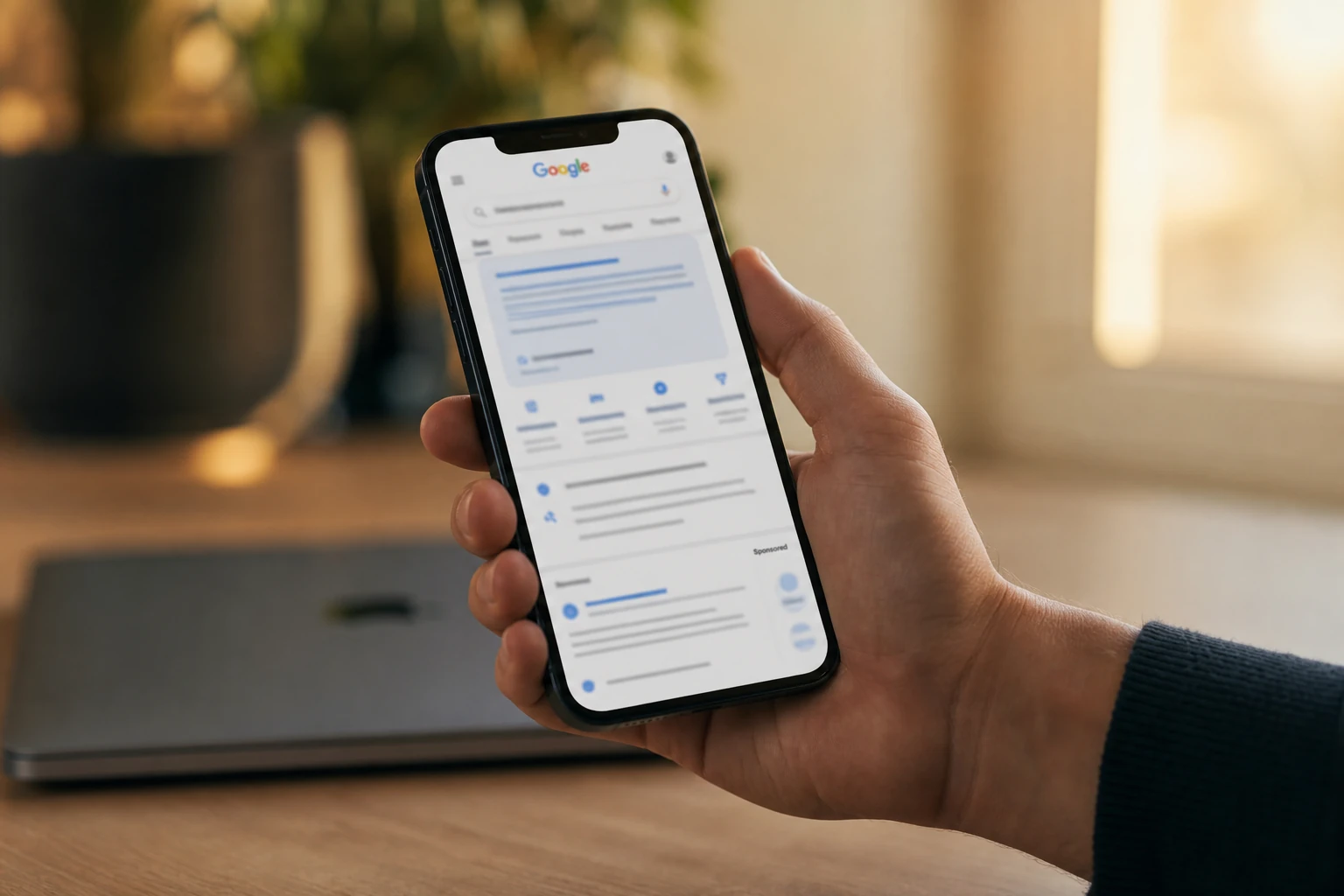
On May 20, 2026, at Google Marketing Live, Google unveiled two new ad formats native to AI Mode: Conversational Discovery ads and Highlighted Answers, per an official announcement on the Google Blog. Both are powered by Gemini, generated on the fly to match a user's question, and inserted directly into the AI response : labeled "Sponsored".
This isn't just another ad format. It's the moment Google admits that the "AI answer" surface is a real commercial inventory. For organic brands (the ones that relied on free citations inside AI Overviews and AI Mode) the line between paid and organic just thinned again.
TL;DR. Google is testing two ad formats inside AI Mode: Conversational Discovery ads (creative dynamically generated by Gemini based on the conversational query's intent) and Highlighted Answers (a sponsored entry injected directly inside an AI recommendation list). US testing, mobile and desktop. No public launch date. Both keep a "Sponsored" label. For small businesses: visibility in AI Mode is now a hybrid organic + paid battle, and indexed brand content remains the only free lever.
What Google announced exactly
Two formats in test, designed for two different query types.
Conversational Discovery ads
Built for exploratory, long, fuzzy-intent queries. Gemini analyzes the intent behind a conversational question, then generates a tailored ad creative: headline, description, highlighted product attributes, adapted to the user's exact phrasing. Search Engine Journal cites Google's example: a user asking "how do I make my house smell like a fancy spa or a rainy forest" with low maintenance. Gemini then surfaces an ad that matches that nuanced intent, instead of an ad targeted on a static keyword. Details on Search Engine Journal.
Highlighted Answers
Built for "list" queries and recommendations. When AI Mode answers with a list of suggestions (best language-learning apps for an upcoming trip, best robot vacuums, best foodie weekend cities), a high-quality sponsored ad can appear inside the list itself, visually embedded among the organic answers. Google specifies that a Gemini-written independent "explainer" sits alongside the placement : a piece of text that describes what the product does, separate from the advertiser's own creative. Search Engine Land confirms both formats are in US testing, on mobile and desktop, with no public launch date. Search Engine Land article, May 20, 2026.
Key context numbers
Why this isn't just "one more ad slot"
Three shifts to understand.
First, the creative is no longer static. With Conversational Discovery ads, Gemini rewrites the ad in real time based on the query. Keyword targeting becomes secondary : the algorithm reads the broader intent, conversation context, sometimes earlier turns. For the advertiser, that means product feed quality and site semantics matter as much as the bid. Cicero already observed this on the first OpenAI Ads Manager tests on the ChatGPT side: without structured content, Gemini has nothing to generate from.
Second, the placement is integrated, not adjacent. Highlighted Answers don't sit above or beside the answer : they're part of the answer. Visually, a user scans a list of 5 recommendations where 1 is sponsored. The "Sponsored" label is there, but the eye doesn't read it as a top-of-SERP ad: it reads it as one item among others. It mirrors the strategy OpenAI rolled out on the ChatGPT side in parallel.
Third, the inventory is huge. Google confirmed 1 billion monthly AI Mode users and 2.5 billion AI Overviews users at the Google I/O keynote on May 19, 2026. Every conversational query is a potential impression. At that scale, pressure on organic surfaces will rise : not abruptly, but structurally.
What it means for SMBs
- Free citations are still possible, just on a smaller stage. If you used to appear in a "top 5 accounting tools for SMBs" list in AI Mode, a Highlighted Answer demotes your position. You stay visible, but next to a paid actor : who will often win clicks thanks to the embedded design.
- Product semantics become an asset for paid as much as organic. Gemini reads your site to generate explainers and creatives. A fuzzy product page with no structured data and no clear benefits will hurt you in both disciplines at once. See our method to appear in ChatGPT and AI Overviews.
- The US test is just a US test : for now. No international rollout is announced. But the recent track record (AI Mode went from US-only to 98 languages in six months) suggests the non-English window is measured in quarters, not years. Preparing now = being ready before competing advertisers.
Action plan : what to do this week
- Map your priority "list" queries. Build the list of 20-30 queries where you appear (or want to appear) inside an AI Overview formatted as "top X" or "best of". Those are the inventories most exposed to Highlighted Answers. Measure your current position.
- Tighten product readability. On every key service or product page: clear title, 3 benefits in bullets,
ProductorServicestructured data, quantified citations. That's what Gemini reads to decide who makes the list and who doesn't. See our analysis on Google's "preferred source" label. - Monitor AI Mode as a separate channel. Stop bundling it with "Google organic" in your reports. Build a dedicated view. Behaviors (CTR, session time, conversion) already differ and will diverge further as native ads roll out.
What this announcement doesn't cover
Three caveats. First, the test is confined to the US with no public launch date. Any aggressive non-US plan is premature. Second, Google hasn't published any CTR, CPM, or impact-on-existing-Search-ads metric : the real effect on paid budgets remains to be measured. Third, the independent "Gemini explainer" can, in theory, contradict the advertiser if product quality doesn't hold up. That's a new kind of risk for paid search: Google itself generates an opinion on product relevance. Brands with weak value propositions risk having their own campaigns work against them.
The Cicero take
This isn't a rupture, it's a formalization. Google had already tested the idea of ads inside AI Overviews since 2024. What we're seeing in May 2026 is the industrial version: a dedicated format, a product narrative, a clear label, and a 1-billion-user rollout in sight. For paid search advertisers, the signal is to prepare "conversational" creative right now : not to wait for international rollouts.
For organic brands, the lesson is harder. Free real estate inside AI Mode will shrink, not by algorithmic rule, but by inventory competition. A paid slot inserted into a list of 5 mechanically reduces attention given to the other 4. The counter remains the same: get cited as a primary source (not as a comparison item), build editorial authority that no advertiser can fake in 48 hours.
At Cicero, we work the AI citation layer for 100% of the content we produce. That's our method: GEO audit + editorial production + automated semantic linking. Agency-quality work, software-grade productivity.
Sources
- → Google Blog (May 20, 2026) : official announcement of the new AI Mode ad formats at Google Marketing Live 2026
- → Search Engine Land (May 20, 2026) : mechanics of Conversational Discovery + Highlighted Answers
- → Search Engine Journal (May 2026) : concrete examples and creative implications
- → Google Blog : Search at I/O 2026 : AI Mode (1B) and AI Overviews (2.5B) usage figures

Growth and SEO content strategist, I founded Cicéro to help businesses build lasting organic visibility : on Google and in AI-generated answers alike. Every piece of content we produce is designed to convert, not just to exist.
LinkedIn