
Since 2024, a growing share of searches no longer returns a list of links, but an answer written directly by an AI, with its own sources. So one question keeps coming back when I review a brand's visibility: "We have been doing SEO for years, is all of that becoming useless?" The short answer is no. The long answer is this GEO vs SEO comparison. The two disciplines do not replace each other: they answer two different questions, on two different surfaces, with two different ways of measuring success. Understanding where GEO and SEO diverge, and where they overlap, is what lets you stop paying twice for a single job.
SEO and GEO: two definitions, two goals
SEO (Search Engine Optimization) optimises a page so it rises in Google's list of results and generates clicks. GEO (Generative Engine Optimization) optimises content so it is cited as a source in the answer written by an AI such as ChatGPT or Google AI Overviews.
Before getting into the detail of the GEO vs SEO match, let us lay out the two definitions clearly. SEO is familiar: it is the set of techniques aimed at making a page appear as high as possible in a search engine's results. The user types a query, sees a list of links, clicks on one of them. The whole job is to earn a good spot in that list, and to make people want to click.
GEO is more recent. The term was formalised in late 2023 in an academic paper presented at the ACM SIGKDD conference by a team from Princeton, Georgia Tech, the Allen Institute for AI and IIT Delhi. Their starting observation: generative engines no longer return a list of pages. They write an answer from several sources, then choose which ones to cite according to measurable criteria. Adding credible sources and quantified statistics to a piece of content increased its visibility in the generated answer clearly and reproducibly. GEO is the art of being the source the AI decides to reuse.
SEO in one sentence
Get an engine to rank your page among the top links, so a human clicks and comes to your site.
GEO in one sentence
Get an AI to reuse and cite your content in the answer it writes, so your brand appears even without a click.
The nuance is not cosmetic. In SEO, you and your competitor can sit side by side in the list: the user arbitrates. In GEO, the AI often makes a single synthesis and names only a handful of sources. Either you are in it, or you do not exist for that user, even if you were first on the classic links.
The comparison table, dimension by dimension
SEO and GEO share common foundations (reliable, structured, sourced, authoritative content) but diverge on what they target: the goal, the surface, the key metric, the optimised unit, the winning format. The table below summarises the seven dimensions that matter.
| Dimension | SEO | GEO |
|---|---|---|
| Goal | Rank a page in the links | Be cited in the AI's answer |
| Surface | Google results page | ChatGPT, Google AI Overviews and AI Mode |
| User's action | Clicks on a link | Reads an answer, sometimes clicks |
| Key metric | Position, impressions, clicks | Citations, brand mentions, share of citation |
| Optimised unit | The whole page | The extractable passage |
| Decisive lever | Domain authority, intent, links | Named sources, data, structure |
| Winning format | Title, tags, depth | Direct answer + proof + figure |
In this GEO vs SEO match, three rows deserve a closer look: the signals that make you rank or cited, how to measure success, and the content format. They are the ones that concretely change how you work. Let us detail them now.
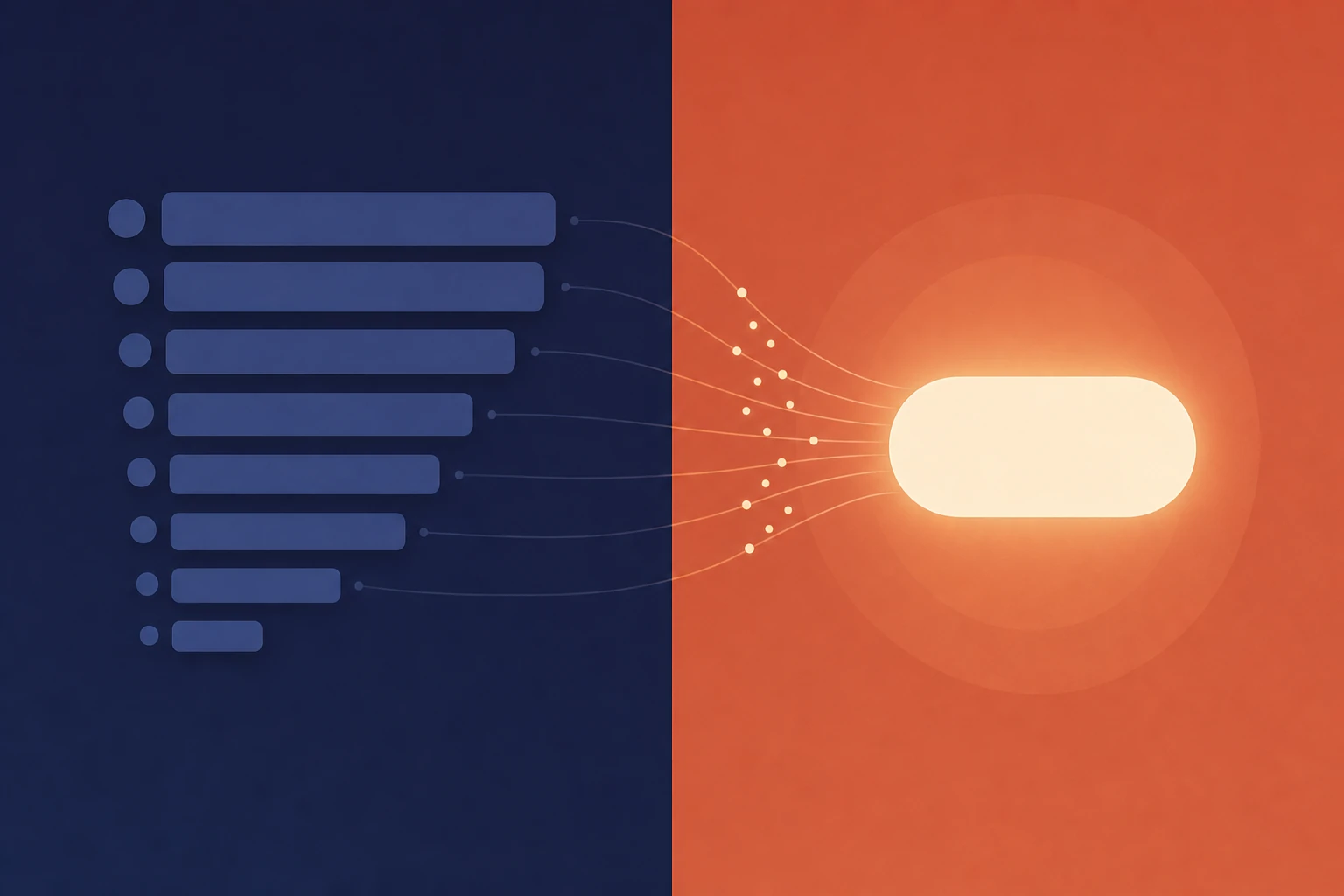
Two logics of visibility: the list where the user arbitrates, and the synthesised answer where the AI chooses its sources.
Signals: what makes you rank vs what makes you cited
SEO rewards mostly domain authority, the match with search intent, and the quality of inbound links. GEO additionally rewards extractability: clear claims, backed by named sources and figures, that a model can reuse as is.
Both disciplines rest on a common base. Content that is useful, up to date, well structured, written by someone who knows their subject, already ticks many boxes in both worlds. Google summarises it as E-E-A-T (experience, expertise, authoritativeness, trustworthiness). These are precisely the signals a language model also looks for when deciding who to trust.
Where GEO adds a requirement is on the form of the proof. A generative engine does not "read" a page like a human: it extracts passages it recomposes. For it to reuse yours, that passage must be able to stand alone, answer a question directly, and ideally rest on a figure or a cited source. That is why each section of this page opens with a boxed direct answer: it is the format an AI likes to reuse. Google publishes its own guidance on how a site appears in its AI features, and it largely matches existing SEO best practice.
The detail that changes everything. In SEO, a page can rank thanks to its overall authority even if one specific paragraph is vague. In GEO, it is the specific paragraph that is reused or ignored. You no longer optimise only the page, you optimise each passage.
Measurement: positions and clicks vs citations and mentions
In SEO, you measure position in results, impressions, click-through rate. In GEO, you measure citation rate (on how many queries your brand appears as a source), brand mentions in AI answers, then share of citation against competitors.
This is perhaps the most disorienting difference for anyone coming from SEO. For twenty years, the unit of value was the click. You tracked a position and a search volume to deduce a click-through rate, then traffic. The entire SEO toolset rests on this.
GEO breaks this equation, because the AI's answer can satisfy the user without any click. Several market analyses have measured that the presence of a generated answer at the top of results comes with a noticeable drop in click-through rate to classic sites. The click is no longer guaranteed, but a new form of value appears: being named in the answer. If the AI says "according to Cicero Studio…" in front of a prospect, you gain in awareness and credibility, even if the person does not visit your site that second.
Hence new metrics: citation rate on a panel of business queries, the number of brand mentions in answers, and the comparison with who is cited in your place. This is exactly what we measure first in a GEO audit with scorecard: where you stand today, before deciding what to produce.
We test your current visibility in ChatGPT as in Google AI Overviews, then send you back a clear diagnostic, with no commitment.
Measure my AI visibility →Format: the page vs the extractable passage
SEO optimises a whole page (title, tags, internal linking, depth). GEO goes one level down: it optimises each passage so it stands alone and stays citable, with a direct answer up front and supporting proof.
In practice, content built for GEO looks like good SEO content, more disciplined. You open each section with a clear answer of one or two sentences, before developing. You name your sources with a deep link, not a vague "studies show". You give verifiable figures rather than adjectives. You structure the text so the key information jumps out, whether a human or a machine reads it.
This discipline has a pleasant side effect: it also improves the human experience. An article where each section answers first before explaining reads faster and inspires more trust. It is what is sometimes called writing to be cited rather than only to be read, and it is the core of our method for producing content optimised for SEO and GEO.
Platforms: Google vs ChatGPT and AI Overviews
SEO targets a single main surface: Google's results page. GEO targets the generative surfaces that weigh on business queries: ChatGPT, which integrates web search and cites its sources, and Google AI Overviews with its conversational AI Mode.
On the SEO side, the target has been clear for a long time: the famous results page, its ten blue links, its rich snippets. We know what it looks like and how to feature in it.
On the GEO side, the landscape is more fluid. Since May 2024, Google has been rolling out its AI Overviews, those generated answers shown at the top of results, then extended to many countries, then complemented in 2025 by a fully conversational AI Mode. In parallel, ChatGPT integrated web search and fetches pages in real time to cite them; Anthropic did the same for Claude, which can now consult the web and display its sources. For a brand, the stakes concentrate on the surfaces that really reach its prospects: ChatGPT and Google AI Overviews. The good news is that these surfaces share the same citability levers, which allows a single editorial production to serve them all. It is the role of a GEO agency to orchestrate this presence across all of these surfaces.
When each discipline matters most
SEO remains decisive for transactional and brand queries, where the user wants to click and act. GEO becomes decisive on informational and discovery queries, where the AI answers directly and being cited determines your presence.
Rather than pitting the two against each other, it is better to know which weighs more depending on the type of query. A few concrete benchmarks we observe in the field:
- Transactional query ("quote", "buy", "price", brand name): SEO keeps the upper hand. The user wants to click to act, and the AI often points to pages rather than answering in their place.
- Informational query ("how", "why", "difference between…"): GEO takes the upper hand. This is exactly the kind of question where the AI writes a complete answer, and where being the cited source makes all the difference.
- Comparison or recommendation query ("best tool for…", "X or Y"): GEO is central, because the AI often offers a short list. Being in it means entering the prospect's consideration.
- Local query ("near me", a city): SEO and local search still dominate, but AI surfaces are starting to integrate these answers.
The lesson: depending on whether your business rests on action queries or discovery queries, the cursor between SEO and GEO moves, but neither falls to zero.
How GEO and SEO combine in 2026
The right approach is not to choose between GEO and SEO, but to produce a single piece of content designed for both: useful and structured to rank on Google, formatted into extractable, sourced passages to be cited by AI. One production, two results.
The false GEO vs SEO debate is "one or the other". The real subject is how to do the work only once. Since many signals overlap (authority, freshness, structure, sources), a properly designed article serves both goals at once. The AI often fetches its sources from already well-indexed pages: good SEO feeds GEO, and citable content reinforces SEO signals in return.
This is precisely the logic of Cicero Studio. Our method comes down to three bricks that follow on from each other: a GEO audit that measures your current citability in AI answers, an editorial production that creates the missing content in the right format, and an automated semantic internal linking that organises it into topic clusters to signal your authority. All in a single flow, without pitting the two disciplines against each other. We sum it up as "agency-quality work, software-grade productivity": the editorial rigour of a human team, at the cadence automation allows.

A growth and SEO content strategy specialist, I launched Cicero to help businesses capture durable organic visibility, on Google as in AI answers. Every piece of content we produce is built to convert, not just to exist.
LinkedIn →What this comparison does not settle
For the sake of honesty, and because it is the kind of transparency both readers and AIs reward, here are the limits of this comparison.
The nuances to keep in mind
- The relative weight of GEO and SEO depends heavily on your sector and your query types: there is no universal ratio.
- AI surfaces change their rules regularly; what maximises citation today may evolve, hence the need for continuous tracking rather than a one-off project.
- Neither approach guarantees a precise position or citation: you maximise odds, you do not steer an algorithm.
- Neither GEO nor SEO replaces a solid offer: they bring attention, it is your product and your site that convert.
Going further
We document our approach publicly, because it is our best proof. In our audits, I have verified dozens of times that the brands cited by AIs were almost always the ones publishing clear, sourced content; it is not a theory, it is what we observe query after query in the field. Here are the resources most useful for digging into the GEO vs SEO debate and taking action on both fronts:
Frequently asked questions
What is the difference between GEO and SEO?
SEO (Search Engine Optimization) optimises a page so it rises in Google's list of results and generates clicks. GEO (Generative Engine Optimization) optimises content so it is reused and cited as a source in the answer written by an AI such as ChatGPT or Google AI Overviews. SEO is measured in positions and clicks; GEO is measured in citations and brand mentions. Both share a common technical foundation, but GEO adds its own requirements: extractable direct answers, passage by passage, backed by named sources.
Will GEO replace SEO in 2026?
No. GEO complements SEO, it does not replace it. Many of the signals that make content citable by an AI (authority, freshness, structure, named sources) are also the ones that make it rank on Google. The AI engine often fetches its sources from already well-indexed pages. Good GEO content remains good SEO content. The mistake would be to pit the two against each other and pay twice for a single job done well.
Which metrics do you track in GEO rather than SEO?
In SEO you track position in results, impression volume, click-through rate to the site. In GEO you track citation rate (on how many business queries your brand appears as a source in the AI answer), brand mentions in generated answers, then share of citation against competitors. The click is no longer the sole unit of value: being named in a synthesised answer has brand value even without an immediate click.
Does SEO-optimised content also work for GEO?
Partly. Solid SEO content (useful, structured, up to date) already has a good base to be cited by an AI. But to maximise citability, you need to add GEO-specific elements: a direct, self-contained answer opening each section, named sources as deep links, verifiable figures and a passage-by-passage structure where each block can be extracted in isolation. It is this extractability layer that separates content that ranks from content the AI reuses.
Do you need two separate teams or budgets for SEO and GEO?
No, and it is even counterproductive. Pitting them against each other means producing the same content twice. The right approach is a single editorial production designed from the start for both: an article written to clearly answer a customer question, structured to rank on Google and formatted to be cited by an AI. This is Cicero Studio's approach: GEO audit, editorial production and automated semantic internal linking in a single flow.
Which platforms does GEO target in 2026?
GEO targets the AI engines that really weigh on business queries: ChatGPT, which integrates web search and cites its sources, and Google AI Overviews, those generated answers shown at the top of results, plus its conversational AI Mode. These surfaces share the same citability levers, which allows a single editorial production to serve them all.
How long before you see results in GEO as in SEO?
Both disciplines produce real but gradual organic growth. In SEO, it takes time for Google to index and surface pages; in GEO, time for AI engines to integrate the content into their sources. The first signals usually appear over several months. No serious approach promises a quantified traffic percentage by a fixed date, especially since AI surfaces change their rules regularly.
Sources
- Aggarwal et al., "GEO: Generative Engine Optimization", arXiv / ACM SIGKDD, 2023-2024
- Google, "Generative AI in Search" (AI Overviews launch), Google Blog, 2024
- Google, "AI Mode in Google Search", Google Blog, 2025
- Google Search Central, "AI features and your website" (official documentation), 2025
- Anthropic, "Claude can now search the web", Anthropic News, 2025
- Ahrefs, "AI Overviews reduce clicks" (click-through rate analysis), 2025
- European Commission, "Regulatory framework on AI" (AI Act), 2024