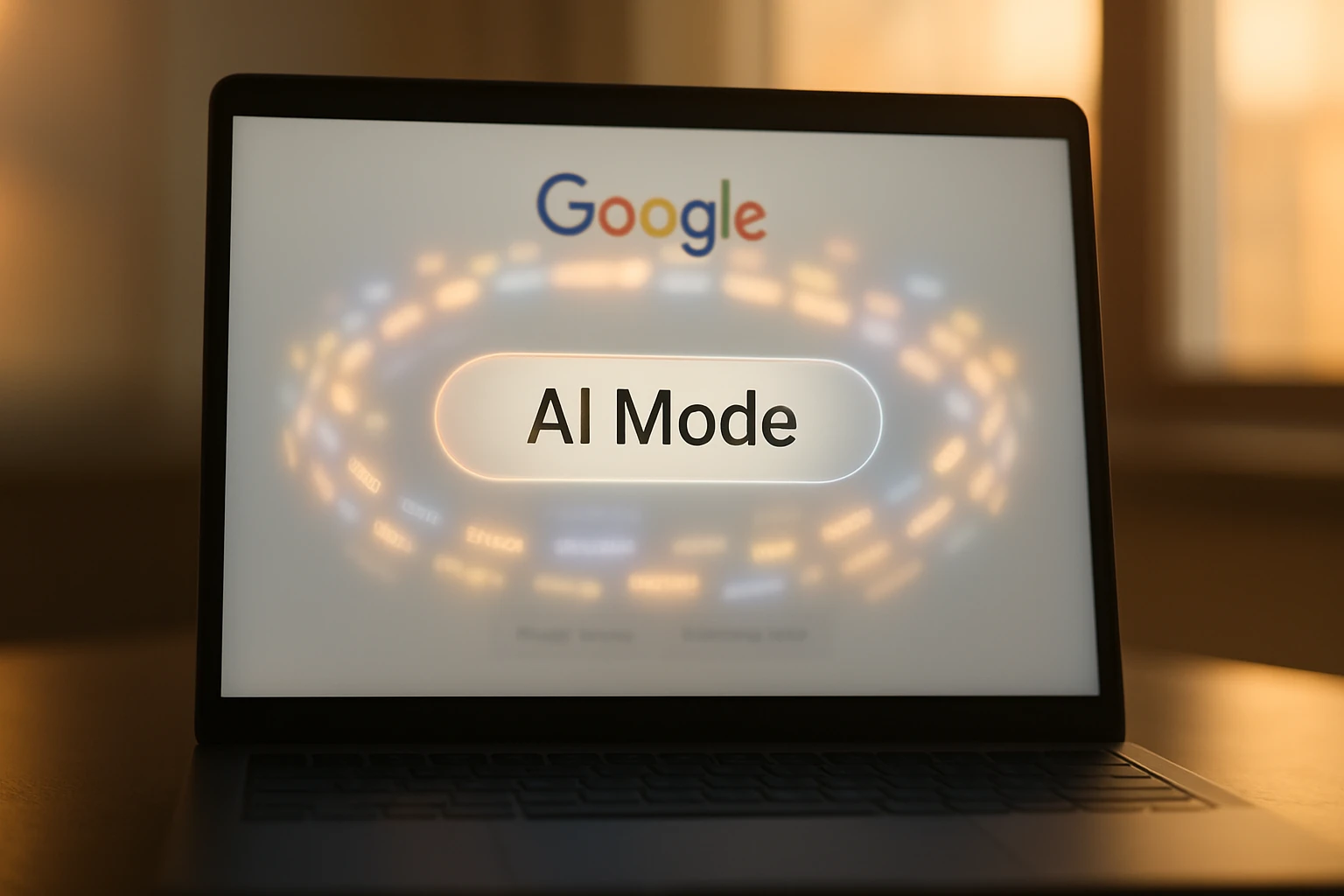
On May 19, 2026, in the opening keynote of Google I/O, Sundar Pichai announced AI Mode had passed one billion monthly active users. Six days later, in a post-keynote interview covered by Search Engine Journal, VP Search Liz Reid spelled out the scope of the rollout: AI Mode and Personal Intelligence are now live in nearly 200 countries and 98 languages, no subscription required. Deployments that used to take "months or even years," she said, now take a few months.
In plain English: French is in, German is in, Italian is in, Arabic is in. The window in which the AI experience was effectively confined to English and a handful of test markets has closed.
TL;DR. Google has flipped AI Mode to global multilingual in a matter of months (versus years for classic Search): 1B MAU, queries doubling every quarter. For non-English SEO teams, the buffer of low-competition AI Overviews is gone : publish now, in formats and entity structures the model can cite.
Why the May 25 update is different from the May 19 keynote
The May 19 keynote delivered the headline number : 1 billion monthly active users on AI Mode and queries "more than doubling every quarter since launch," per Pichai's remarks on the official Google blog.
Liz Reid's interview adds the technical detail most coverage missed: AI Mode's new multilingual model architecture. Reid's exact framing was that AI Mode "reached many, many countries, in many, many languages within a few months." In practice this means the model no longer needs market-by-market retraining. That is what lets Google jump from a handful of major languages to 98 in weeks, skipping the slow regional rollout cadence we saw with Featured Snippets or with Bard.
Key numbers
What it changes for non-English SEO teams
As long as the AI layer was effectively English-only, the competition inside AI Overviews and the new agentic search Google unveiled at I/O 2026 happened in English content. A French, German, or Spanish SMB ranking on its core query rarely got "absorbed" into a synthesized answer in its own language : the AI Overview either didn't trigger, or it triggered rarely.
That window is closing. Once AI Mode runs at full power on French, Spanish, and German queries, three direct consequences:
- Generic evergreen "guide" content gets even less profitable. Google answers directly, users stop clicking. Same mechanism that took organic traffic down 42% on sites studied by Define Media Group in 2025 : coming to European markets next.
- Being cited by the model becomes a brand asset. Showing up in the answer, even without a click, is now a visibility signal in its own right. That requires content engineered for citation: factual claims up front, named entities, linked sources.
- A machine-readable information architecture stops being optional. NewsArticle, FAQPage, Organization with sameAs, clean structured data : that is what the model parses when deciding who to credit.
What to do before July
Three actions, in this order:
- Audit your top-20 queries in your own market. For each, check in incognito whether an AI Overview triggers, and which sources it cites. Those sources (not the classic top-10) are your real competition now.
- Rewrite intros for citability. The first sentence of every article must answer the title's question, self-contained, with no upstream context required. That is what LLMs lift first.
- Publish on the topics the Google information agents will monitor for your prospects: sector news, price updates, regulatory changes. Those agents run 24/7 and feed Personal Intelligence continuously.
The limits of this announcement
Three caveats to keep on file. First, Google has not published the exhaustive list of the 98 languages or a country-by-country rollout schedule : the information comes from an interview, not a numbered press release. Second, "available" doesn't mean "triggered on 100% of queries"; AI Mode remains a contextual trigger, more frequent on informational queries than on transactional ones. Third, the impact on non-English organic traffic has not yet been publicly measured : existing data (Define Media Group, Ahrefs) covers the US market.
The Cicéro take
For six months, the lagging multilingual rollout was the main buffer protecting non-English SEO. That buffer just disappeared in a single interview. Non-English sites that haven't started restructuring their content for LLM citation are about to take the same hit English-language sites took in 2025 : except they'll feel it in July, not in May.
At Cicéro, we already engineer the citation layer into 100% of the content we produce. That's our methodology: GEO audit + editorial production + automated semantic internal linking, from €250/month up to €1,800/month depending on volume. Agency-quality work, software-grade productivity.
Sources
- → Google Blog : Sundar Pichai's I/O 2026 keynote (1B AI Mode MAU, queries doubling quarterly)
- → Search Engine Journal (May 25, 2026) : Liz Reid interview, VP Search
- → Google Blog : 100 things we announced at I/O 2026

Growth and SEO & GEO content strategist, I founded Cicéro to help businesses build lasting organic visibility : on Google and in AI-generated answers alike. Every piece of content we produce is designed to convert, not just to exist.
LinkedIn