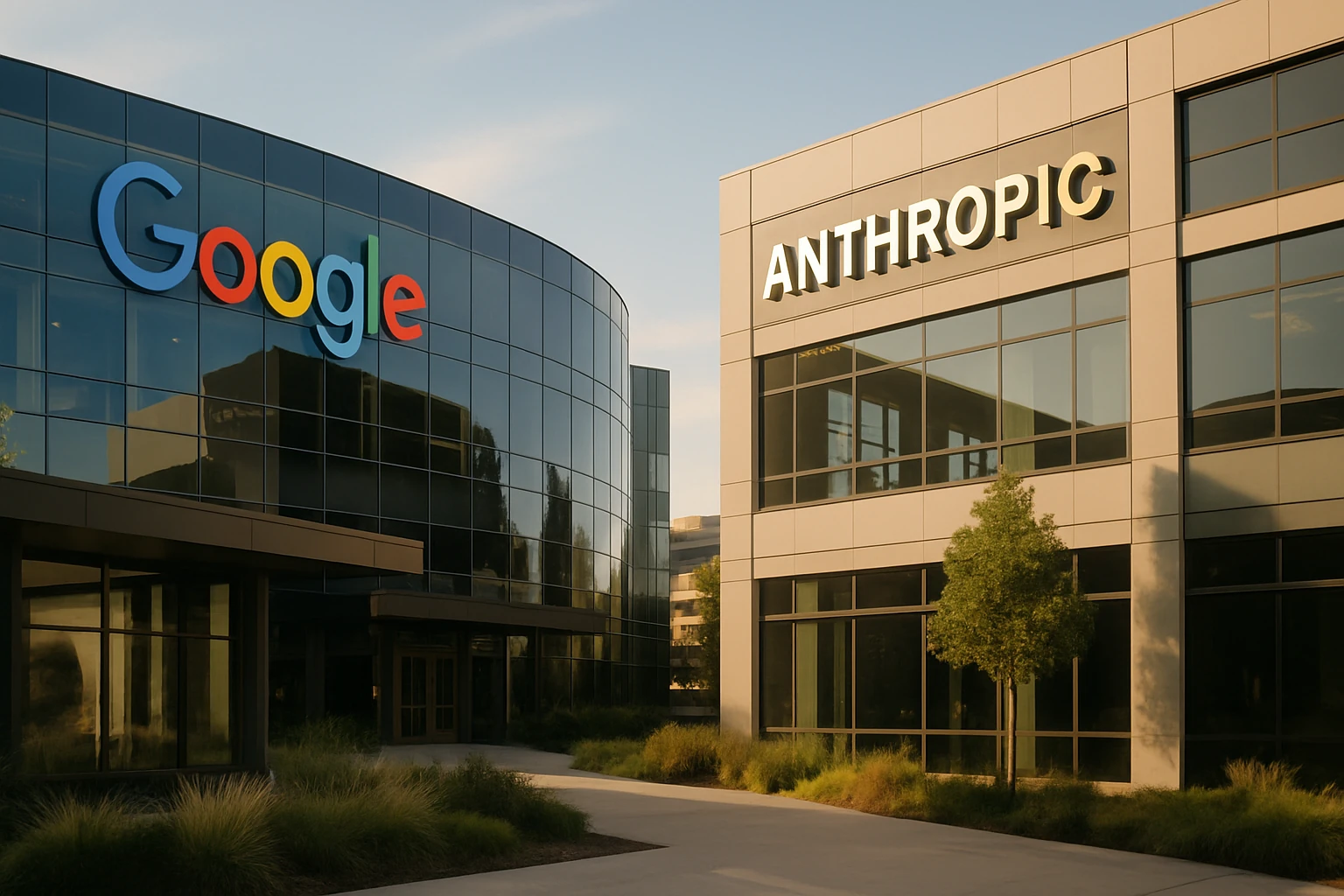
TL;DR: On April 24, 2026, Alphabet (Google) announced an investment of up to $40 billion in Anthropic, the maker of Claude. $10 billion is committed immediately. Google will also provide 5 gigawatts of computing capacity over 5 years. The direct consequence: optimizing your content for Claude now means optimizing for the Google ecosystem. The boundary between SEO and GEO has effectively dissolved.
On April 24, 2026, Alphabet officially announced an initial $10 billion investment in Anthropic, with a total commitment of up to $40 billion if the AI startup meets its growth milestones. According to reports published simultaneously by Bloomberg and TechCrunch. The valuation for this transaction: $350 billion.
This is not an ordinary financial investment. Google Cloud is simultaneously committing to deliver 5 gigawatts of TPU-based computing capacity over a five-year window, the concrete infrastructure Claude needs to scale globally. Amazon is also a major investor in Anthropic, with a separate partnership announced earlier this year.
Key numbers
What it changes for the AI search landscape
Until now, Google and Anthropic were positioned as competitors: Gemini vs. Claude. This deeply capitalized investment reshapes that narrative entirely. Google now holds a significant stake in both major large language model architectures, its own (Gemini) and Anthropic's (Claude).
This matters for understanding where AI search is headed. At Google Cloud Next 2026, the Gemini Enterprise Agent platform already integrated Claude alongside Gemini in its Model Garden. That move was not coincidental, it was the first visible signal of the common ground forming. Today's investment confirms: Google wants diversified AI capabilities, not an internal monopoly.
For your visibility strategy, the implication is direct: AI search tools are drawing from the same source pool. Perplexity, Claude.ai, Google's AI Mode in Search. All of these systems increasingly draw from an interconnected ecosystem of models sharing infrastructure and training approaches.
Concrete impact on your GEO strategy
The GEO playbook published by IBM in April 2026 already stated it clearly: visibility in generative answers does not depend on which engine generates them, but on the structure of the content those engines consume. The Google-Anthropic investment reinforces this logic.
Here's what concretely changes:
- Optimizing for Claude = optimizing for the Google ecosystem. If your content is cited by Claude, it becomes visible in Anthropic-powered interfaces. And potentially in future Google Search features that will leverage Claude via their Model Garden.
- E-E-A-T signals surface across all models. Whether it's Gemini or Claude, both evaluate authority, on-ground expertise, and source verifiability. Publishing proprietary data and signed analyses remains the most reliable citation vector in LLMs.
- AI visibility diversification is no longer optional. Your SEO audit must now include an « LLM citability » component, not just your Google rankings. Adobe's Q1 2026 data shows AI-referred traffic converts 42% better than traditional organic traffic. This channel is growing fast.
What to do right now
The Google-Anthropic announcement is not a future promise, its effects are already unfolding. Here are three concrete actions to start this week:
- Test your Claude citability today. Open Claude.ai and ask specific questions about your industry. Does your brand or content appear in the answers? If not, that's Priority #1 in your next editorial iteration.
- Structure your direct answers at the top of each article. Claude and Gemini both favor content that answers the question in the very first paragraph, before any development. This is the fundamental GEO principle, made even more critical by ecosystem unification.
- Publish data that AI models cannot fabricate. Internal studies, field insights, proprietary figures, these generate citations in LLMs. GPT-5.5 and Claude consume the same types of evidence: dated facts, named sources, identified authors.
Cicero's take
There are two readings of this investment. The first: Google is « buying into » part of the competition to neutralize the Claude risk. The second, which we favor: Google recognizes that AI search will not be dominated by a single model, and wants a stake in every ecosystem that matters.
For content creators, this is good news. The diversification of models means that the intrinsic quality of a piece of content. Its density of verifiable facts, author authority, and AI-readable structure. Is the only truly universal lever. Technical SEO and GEO are converging toward the same criterion: publish something an LLM wants to cite because it's accurate and precise.
Sources
- → Bloomberg, Google plans to invest up to $40 billion in Anthropic, April 24, 2026
- → TechCrunch, Transaction details: cash + compute, April 24, 2026
- → CNBC, Google spreads AI bets, April 24, 2026
Growth and SEO content strategist, I founded Cicéro to help businesses build lasting organic visibility. On Google and in AI-generated answers alike. Every piece of content we produce is designed to convert, not just to exist.
LinkedIn