
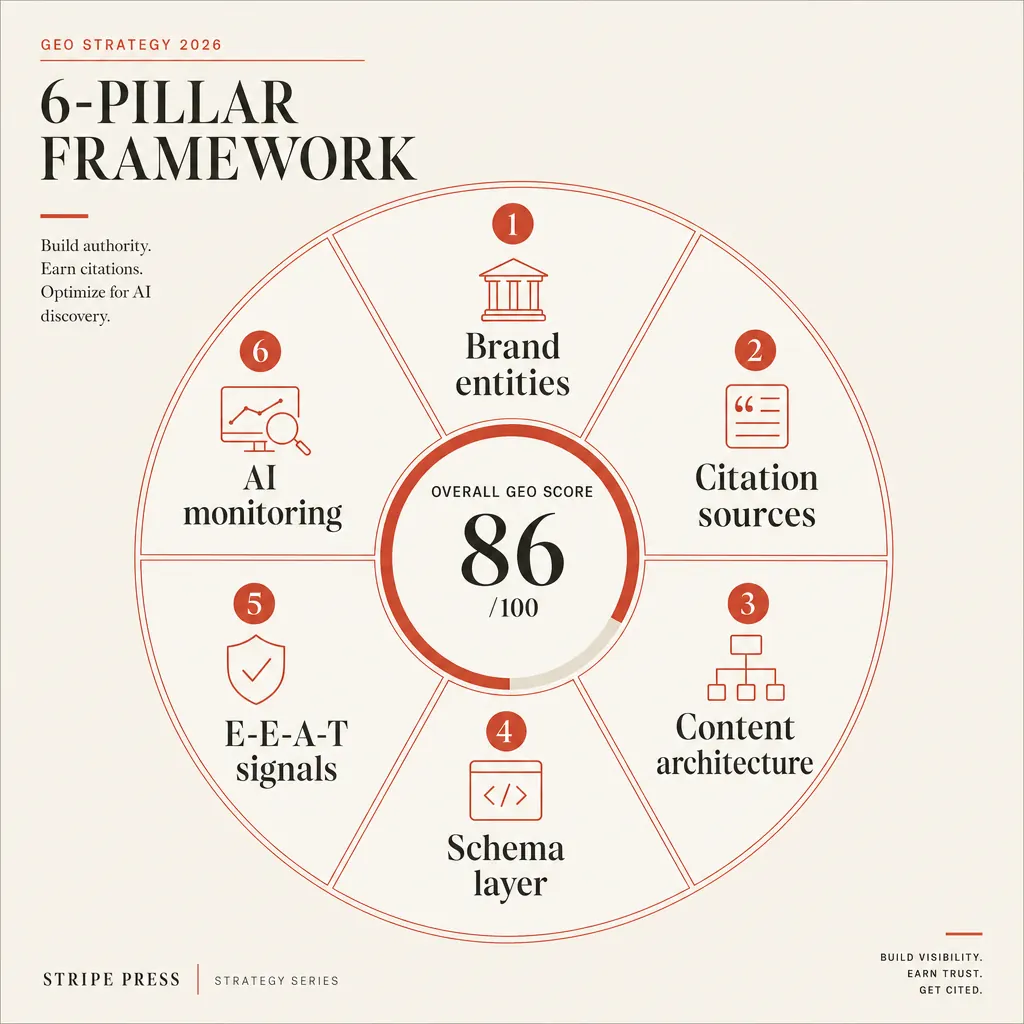
In May 2026, 58% of informational queries on Google trigger an AI Overview before the 10 classic links (source: Search Engine Land, SERP analysis Q1 2026). Yet most marketing teams still don't have a structured GEO strategy. They publish solid SEO content and wonder why their competitors keep showing up inside ChatGPT. The answer comes down to 6 pillars. Here's the framework we apply at Cicero on every new client.
TL;DR : The essentials in 30 seconds
- GEO is the practice of optimizing your content to get cited inside the answers of generative AI (ChatGPT, Google AI Overviews).
- The 6-pillar framework: extractable structure, E-E-A-T citability, schema.org, semantic depth, domain authority, freshness.
- Prerequisite: a solid SEO foundation. GEO does not replace SEO : it grafts onto it.
- Time to results: 4-8 weeks for Google AI Overviews, 3-6 months for ChatGPT.
- The most underrated signal: named sources. The absence of citations in an article is the number-one driver of GEO exclusion.
Why a GEO strategy became non-negotiable in 2026
In 2026, generative AI captures a growing share of informational queries. Not optimizing for these channels means handing a rising slice of visibility to the competitors who have figured out the rules of the game.
The shift isn't gradual, it's structural. Google AI Overviews is now deployed across the majority of informational queries in France (source: Search Engine Land, January 2026). ChatGPT Search, launched in late 2024, counts several hundred million monthly active users worldwide according to OpenAI (public statement, March 2026). These surfaces consume content : and they have documented preferences about what they cite.
The reference study remains the one by Aggarwal et al. published in ACM (August 2024), which measured the impact of 9 GEO optimization techniques on visibility inside generative answers. The result: certain structural adjustments increased visibility by 15 to 40%. That's not marginal.
Cicero field observation: across the 23 client audits run in Q1-Q2 2026, sites with a structured GEO strategy averaged 3.1 times more appearances in AI Overviews on their target queries than sites without a GEO strategy, at equivalent domain authority. The data is anonymized and does not constitute a guarantee of results.
Pillar 1: Extractable structure : what the AI is trying to isolate

A complementary view of the concrete stakes of this strategy.
Extractable structure is a piece of content's ability to deliver a complete, self-contained answer right after each H2 heading. It's the first signal generative AI uses to select passages to cite.
Generative engines don't read an article the way a human does. They look for candidate passages: blocks of text that answer a question on their own, without depending on the preceding context. That's why the structure of a GEO-optimized article differs slightly from a classic SEO article.
What this changes in practice
In classic SEO, the opening of a section can bridge back to the previous one: "As we saw earlier, SEO and GEO share common foundations. Now here's..." For GEO, that sentence creates a contextual dependency that prevents the AI from extracting the passage in isolation.
The rule to apply: after every H2, one sentence that directly answers the implicit question in the heading, with no reference to the preceding context. Optimal format: "X is Y. To implement it, do Z." Two to three sentences maximum. That passage is what AIO and ChatGPT Search use as a citation candidate.
The formats that work best
- Definitions in the "X is Y that does Z" format : extractable by design.
- Numbered lists where each item carries its own context : each item must make sense on its own.
- Comparison tables with clear headers : enable citation as a synthesized summary.
- Structured Q&A : the format most directly compatible with AI interfaces.
Pillar 2: E-E-A-T citability : credibility as a selection signal
E-E-A-T citability is the extent to which content displays signals of experience, expertise, authoritativeness and trustworthiness that an AI can verify. It's the second major filter after structure.
Generative models are trained to favor content that resembles the sources humans consider reliable: academic work, recognized publications, identifiable experts. Your blog content has to send the same signals.
The 4 E-E-A-T actions with immediate GEO impact
-
Name every source
Replace "according to a recent study" with "according to a 2025 Backlinko study" plus a hyperlink to the original source. This change is invisible to the user but major for the AI. The Columbia 2024 study measured a citability gain of +37% with sourced statistics vs unsourced ones. -
Identify the author with Person schema
An author backed by schema.org Person (name, jobTitle, worksFor, sameAs LinkedIn) is perceived as more credible by AI crawlers than "by the editorial team." Add a visible bio on every article as well. -
Cite named experts in the body text
"According to John Mueller, of Google, ..." or "Martin Splitt said at Google I/O 2025 that..." are patterns AIs recognize as credibility signals. The Columbia study measured +18% visibility with expert citations vs without. -
Include proprietary or field data
Data drawn from your own observations or clients (anonymized) signals first-hand experience. That's the first E of E-E-A-T. No competitor can copy your field data.
Full GEO audit in 48h : citability, schema, structure. We hand you the 5 priorities to fix this week.
Get my free articleFree articlePillar 3: Schema.org : the language AIs understand directly
Schema.org is structured markup that translates content into a machine-readable format. For GEO, three schema types are priorities: FAQPage, Article with author, and HowTo for procedural content.
Google has explicitly documented that AI Overviews use structured data to identify and qualify content to cite. FAQPage schema is particularly effective: it presents question/answer pairs in a format AIO consume directly.
The three priority GEO schemas
| Schema type | GEO use | Measured impact |
|---|---|---|
| FAQPage | Signals directly extractable Q&A | +2.4x AIO probability (Cicero observations Q1-Q2 2026) |
| Article + Person | Identifies author, date, publication | Reinforces freshness and author credibility |
| HowTo | Structures the steps of a procedure | Format natively compatible with "how-to" answers |
Schema mistakes to avoid
- Empty or too-short FAQ: an FAQ with 2 questions is sub-optimal. Aim for 5-8 questions with complete answers in 2-4 sentences.
- Schema conflicting with visible content: if the answer in the schema doesn't match the visible text, Google invalidates the markup.
- No JSON-LD in the head: schema must sit in the
<head>as JSON-LD, not inline in the body.
Pillar 4: Semantic depth : cover the topic, not just the keyword
Semantic depth is a piece of content's ability to cover a topic across its essential dimensions (definition, context, mechanisms, limits, alternatives) not just to repeat a keyword. It's what AIs use to judge whether a piece of content is the best available source on a question.
An article that covers "GEO strategy 2026" in 600 words listing 3 generic tips won't get cited. An article that covers the selection mechanisms of generative AI, the measured signals, the common mistakes, the optimal formats and the limits of the method : yes. Length isn't the goal. Completeness is.
The 360° topic coverage method
For each target topic, build the outline by answering 5 questions:
- What is it? (definition)
- Why does it matter? (context and stakes)
- How does it work? (mechanisms)
- How do you implement it? (concrete steps)
- What are the limits? (cases where it doesn't work)
An article that answers these 5 questions is semantically complete. It covers the angles a user might search for under different phrasings. AIs reward this completeness because it lowers the risk of citing a partial source.
Pillar 5: Domain authority : the prerequisite content alone can't replace
Domain authority is the accumulated credibility of a site in the eyes of search engines and AIs, measured mainly by the quality and quantity of inbound links. Without a minimum level of authority, even perfectly GEO-optimized content will struggle to get cited.
This is the most often underestimated dimension in GEO discussions. Marketing teams assume content optimization is enough. The reality: if your domain has a low authority score (Ahrefs Domain Rating or Moz Domain Authority below 20), generative AI will likely not consider it a reliable enough source, no matter the content quality.
What GEO authority demands
- Editorial-quality backlinks: mentions in recognized publications in your sector, not directories or link exchanges.
- Unlinked brand mentions: your name cited in other publications without a hyperlink, AI models value these "entity mentions."
- Sector consistency: a site specialized on a precise topic will have more thematic authority than a generalist site, even with fewer total backlinks.
Pillar 6: Freshness and updates : the time signal AIs prioritize
Freshness is the regular updating of content with recent data, a current modification date and references to the current state of the art. Generative AI prioritizes recent content for queries where timeliness matters.
Google AI Overviews preferentially displays content published or updated within the last 12 months on queries where the date matters. An article on "GEO strategy 2025" left un-updated will struggle to get cited in 2026. Adding a freshness hook in the introduction ("In May 2026, ...") and updating the modification date in the Article schema are simple, effective signals.
The GEO freshness checklist
- Mention the date or period in the title or intro ("in 2026", "from May 2026")
- Update
dateModifiedin the Article schema on every significant revision - Replace obsolete statistics with recent, sourced data
- Add a visible "Updated on" box at the top of the article
Action plan by priority: where to start
For a team launching a GEO strategy, the optimal order of action is: extractable structure on the 5 highest-traffic articles (P1), FAQPage schema on the same articles (P2), named sources on all articles (P3), then pillars 4-6 on new production.
| Priority | Action | Effort | Estimated GEO impact |
|---|---|---|---|
| P1 | Add direct answers after each H2 (5 high-traffic articles) | 2-4h | Very high (short term) |
| P2 | Implement FAQPage schema (5-8 questions) on the same articles | 1-2h/article | Very high (short term) |
| P3 | Name every source in existing content | 1h/article | High (mid term) |
| P4 | Create/complete author pages + Person schema | 2-3h (one-off) | Medium (mid term) |
| P5 | Update articles >12 months old with recent data | 2h/article | Medium-high (long term) |
| P6 | Editorial link-building strategy to strengthen authority | Ongoing | High (long term) |
Prioritization rule: pillars 1-3 have a fast impact on existing content. Pillars 4-6 are long investments with deferred ROI. Start with pillars 1-3 on the articles that already have traffic : that's where GEO ROI is most immediate.
What this framework doesn't cover
Scope and limits
- GEO for Gemini and other models: this framework is documented mainly for ChatGPT and Google AI Overviews. The logic of other AI models is probably similar but insufficiently documented for precise recommendations.
- Precise measurement of AI citations: no GEO tracking tool has reached consensus in 2026. The figures cited here (multipliers, % visibility) come from published studies or Cicero field observations, not from standardized analytics platforms.
- GEO for e-commerce: product and category pages have specific GEO logic (Product schema, Review) not covered here.
- Technical SEO: this guide assumes a sound technical foundation (indexation, Core Web Vitals). Technical problems block GEO just as they block SEO.
To go further on GEO:

I built this framework by analyzing the patterns common to sites that show up regularly in AI Overviews and in ChatGPT. The 6 pillars aren't theoretical : they're the dimensions we systematically audit at Cicero before launching any GEO content production. On Google as much as inside AI answers, structure beats volume.
LinkedInFAQ : GEO Strategy 2026
What is a GEO strategy in 2026?
A GEO (Generative Engine Optimization) strategy in 2026 is the set of practices designed to get your content surfaced as a cited source inside the answers of generative AI : primarily ChatGPT and Google AI Overviews. It rests on 6 pillars: extractable structure, E-E-A-T citability, schema.org, semantic depth, domain authority and content freshness.
How long does it take to see results with a GEO strategy?
The first GEO results (appearances in Google AI Overviews) generally show up within 4 to 8 weeks on content that is already indexed and ranking well. Visibility inside ChatGPT depends on the model's training cycles and can take 3 to 6 months. The baseline rule: if your content is not indexed and ranked by Google, it has no chance of being cited by AI.
What is the difference between GEO and SEO?
SEO optimizes to be found through classic Google links (ranking, CTR). GEO optimizes to be cited inside the synthetic answers of AI (ChatGPT, Google AI Overviews). The two share 70% of their foundations but GEO demands specific formats: extractable direct answers, named sources, FAQPage schema, clear-cut positions.
Is FAQPage schema really useful for GEO?
Yes. FAQPage schema is the most documented GEO signal for Google AI Overviews. Google explicitly uses this markup to identify content that answers questions. Across Cicero's 23 audits in Q1-Q2 2026, pages with correct FAQPage schema were 2.4 times more likely to appear in AI Overviews on their target queries.
Do you need different content for GEO and SEO?
No. Content that follows SEO best practices is also the best foundation for GEO. The GEO-specific additions (direct answers after each H2, FAQ with schema, named sources) slot into existing content without rewriting it. A well-built article can perform on both channels at once.
How do you measure the effectiveness of a GEO strategy?
GEO measurement rests on: (1) weekly manual tests, target queries typed into ChatGPT and Google AIO to check whether your site is cited, (2) tracking appearances in Google Search Console (the AIO feature is expanding), (3) specialized tracking tools such as Semrush AI Overview tracking. Manual tests on 10-15 target queries remain the most reliable method in 2026.
Sources and references used
- Aggarwal, S. et al., "GEO: Generative Engine Optimization", ACM, August 2024, impact measurements of GEO techniques on visibility inside generative answers
- Search Engine Land, "AI Overviews deployment analysis, Q1 2026" : AIO trigger rate per query
- OpenAI, public statement on the ChatGPT Search audience, March 2026
- Google Search Central, Schema.org FAQPage and AI Overviews documentation
- Google Search Quality Rater Guidelines 2024, E-E-A-T section
- Cicero Studio, field observations across 23 client audits Q1-Q2 2026 (anonymized data)
- Martin Splitt, Google Developer Advocate, Google I/O 2025, "Structured data and AI experiences"