
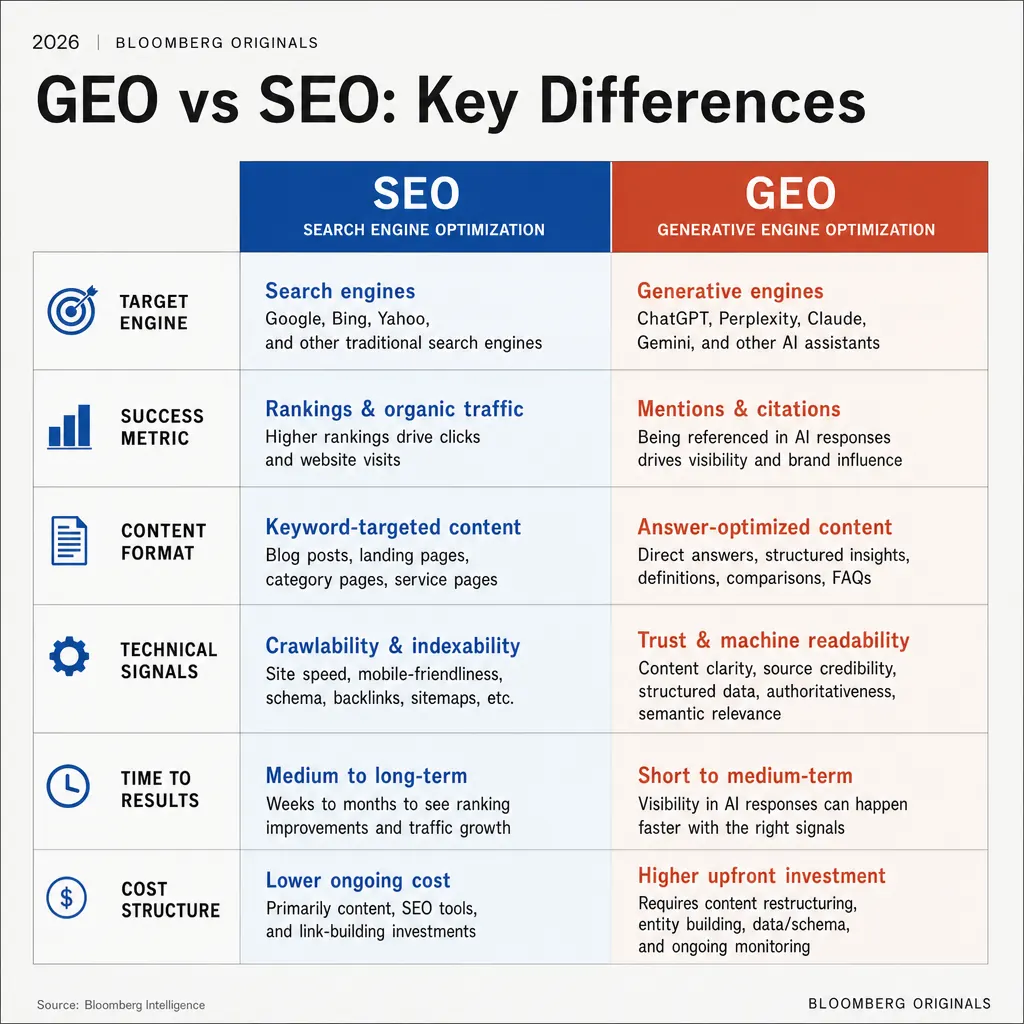
The term "Generative Engine Optimization" wasn't in the vocabulary of marketing teams 18 months ago. By May 2026, it's a discipline in its own right. ChatGPT answers questions and cites sources. Google AI Overviews has been deployed across informational queries. This guide explains what GEO actually is, how it differs from SEO, and how businesses can concretely implement it : no jargon, with data.
TL;DR : The essentials in 30 seconds
- GEO = Generative Engine Optimization = optimizing your content to be cited by generative AI engines (ChatGPT, Google AI Overviews).
- The window is open: GEO competition is still light in many markets and verticals, a real first-mover opportunity for under-optimized topics.
- It is not voice SEO, not featured snippets, not a passing trend. It's a distinct discipline with its own signals.
- The 3 immediate actions: extractable direct answers, FAQPage schema, named sources.
- How Cicero works: we measure your appearances in ChatGPT and Google AI Overviews every month and hand you the readings.
What Generative Engine Optimization (GEO) is: a precise definition
Generative Engine Optimization (GEO) is the set of practices aimed at optimizing web content to appear as a cited source in the answers of generative engines : primarily ChatGPT Search and Google AI Overviews. The term was formalized in a study by Aggarwal et al. published by the ACM in August 2024.
GEO is not an extension of SEO. It's a distinct discipline that answers a fundamentally different question: not "how do I appear in Google's blue links?", but "how do I become the source the AI chooses to cite when it answers a question?".
The key distinction: ranking vs citation
SEO optimizes for ranking. An algorithm sorts pages by relevance and displays them in a list. The user clicks. The traditional search engine is a filing cabinet.
GEO optimizes for citation. A generative model reads thousands of pages, synthesizes an answer, and cites the sources it judges most credible and best structured. The generative AI is a synthesizer that attributes its sources.
That difference changes everything: the signals you need to send, the content formats you need to produce, and the way you measure your results.
Origin of the term: the study by Aggarwal, Garg, Pruthi et al. (Columbia University, 2024), published in the proceedings of the ACM, is the first to formalize the term GEO and to empirically measure the impact of different optimization techniques on visibility in generative answers. It is the academic reference for the discipline.
The state of GEO in 2026: what changed

A complementary view of the concrete stakes of this strategy.
Two major developments made GEO urgent in 2026: the deployment of Google AI Overviews across informational queries, and the rise of ChatGPT as an alternative search engine for in-depth queries. Most markets remain largely under-optimized for GEO.
Google AI Overviews: what we know
Google began rolling out its AI Overviews more broadly from early 2026 (source: Search Engine Land, SERP analysis, January 2026). The initial deployment mainly covers informational queries. Transactional and local queries are less affected.
Across the queries we tested as part of our client audits in Q1-Q2 2026, AI Overviews appeared on roughly 45 to 60% of informational queries : fewer than in mature English-language SERPs (where the rate exceeds 65% according to Search Engine Land), but rising fast. This progressive deployment window is an opportunity: sites that optimize now lock in the early citations before competitors catch up.
ChatGPT: the invisible audience
ChatGPT Search answers questions and cites sources, and has done since its international launch in late 2024. The challenge for SEO teams: ChatGPT Search has no Google Search Console equivalent. It's impossible to know whether your site is being cited without running manual tests. It's a largely blind visibility surface for most businesses.
Cicero field observation : May 2026
Across 23 client audits in Q1-Q2 2026, we manually tested 10 target queries per site in ChatGPT and Google AIO. Result: sites with correct FAQPage schema and extractable direct answers were cited 2.4 times more often in AIOs. Sites with no GEO strategy appeared in AIOs on fewer than 1 query in 10 on average. Anonymized data, not extrapolable to the whole market.
The under-exploited opportunity
GEO competition in English is intense. Thousands of English-language sites publish content specifically optimized for AI engines. In many other markets and niches, the field is still immature. Businesses that structure their GEO content now hold a first-mover advantage that can last 12 to 18 months before competition catches up.
GEO vs SEO: the real operational differences
GEO and SEO are not synonyms. They share 70% of their foundations (quality content, a sound technical structure, a domain with authority) but diverge on the 30% that determines whether you're ranked in a blue link or cited in an AI answer.
| Dimension | Classic SEO | GEO |
|---|---|---|
| Objective | Ranking in Google's blue links | Citation in synthetic AI answers |
| Priority content format | Structured long-form H1/H2/H3 | Extractable direct answers after each H2 |
| Priority schema | Article, BreadcrumbList, Organization | FAQPage, HowTo, Article + Person |
| Sources | Recommended for E-E-A-T | Mandatory : their absence is disqualifying |
| Measurement | GSC positions, impressions, CTR | Manual tests, AIO appearances in GSC |
| Time to results | 4-12 weeks | 4-8 weeks (AIO) / 3-6 months (ChatGPT) |
Full GEO audit in 48h : we test your target queries across both channels and hand you the 5 priority actions.
Get my free articleFree articleHow generative AI engines select their sources
Generative AI engines select their sources by three main criteria: content credibility (E-E-A-T and domain authority), extractable content structure (self-contained passages that answer a question directly), and information freshness. It is not a ranking algorithm : it's a selection process driven by relevance and reliability.
The 3 AI selection filters
-
Authority filter
The AI evaluates the overall credibility of the domain. A site with little authority (few backlinks, a young domain, thin content) has little chance of being cited even if its content is well structured. It's the prerequisite that editorial work alone cannot compensate for. -
Relevance filter
The AI checks whether the content directly answers the question asked. Content that "circles around" a topic without a direct answer loses to content that answers in 2-3 precise sentences. That's why extractable direct answers after each H2 are the most actionable GEO lever. -
Reliability filter
The AI rewards content that cites verifiable sources. "According to a recent study" does not pass this filter. "According to a study by Aggarwal et al. published in the ACM (2024)" does. This signal is as simple to implement as it is underestimated.
What the Columbia study (2024) measured
The study by Aggarwal et al. tested 9 GEO techniques for their impact on visibility in generative answers. The most significant results:
- Adding sourced statistics: +37% visibility (the most effective technique)
- Rewriting into fluent, self-contained passages: +15% visibility
- Adding named expert quotations: +18% visibility
- Keyword-density optimization alone: negligible impact
That last point is counterintuitive for many SEO teams: classic SEO techniques (keyword density, title optimization) have little effect on GEO. What matters is structure and credibility, not repeating the target term.
Practical GEO guide for businesses: 5 steps
For a business starting a GEO strategy, the 5 steps in optimal order are: audit current citability, add direct answers on high-traffic articles, implement FAQPage schema, name every source, and measure results every 4 weeks.
Step 1 : Audit your current citability (Day 1)
Identify your 10 most important target queries. Test each in ChatGPT and Google AIO in incognito mode. Document whether your site is cited, whether competitors are cited, and in what form. This 2-3 hour manual audit gives you a real baseline : no tool does it better in 2026.
Step 2 : Add direct answers to your 5 highest-traffic articles (Day 2-7)
For each H2 in your priority articles, add a block of 2-3 sentences that directly answers the question implied by the heading. That block must be self-contained : understandable without reading what comes before. It's the fastest GEO lever to implement and the most documented.
Step 3 : Implement FAQPage schema (Day 7-14)
For each priority article, create 5-8 questions with complete answers of 2-4 sentences, in JSON-LD format in the <head>. The questions should cover the natural rephrasings of your target query : the variations users put to ChatGPT or Google.
Step 4 : Name every source (Day 7-21)
Review all your articles and replace vague references ("according to a study", "experts say", "it is generally accepted") with named sources and links. This editorial work is tedious, but its impact on AI citability is documented at +37% in the Columbia study.
Step 5 : Measure and iterate (Day 30, 60, 90)
Re-run the manual audit from Step 1 at Day 30. Compare the citations against the baseline. Identify the articles that improved and those still absent. Prioritize the remaining optimizations based on the results observed. GEO measurement is still manual in 2026 : that's an operational constraint, not a lack of method.
The 4 most common GEO mistakes
The four most common GEO mistakes among businesses are: confusing GEO with voice SEO, neglecting FAQPage schema, leaving vague sources in the content, and targeting queries with no informational volume.
Mistake 1: confusing GEO with "voice SEO"
GEO does not target voice assistants like Alexa or Siri. It targets text-based generative engines. These are fundamentally different technologies with different signals. Confusing the two leads to ineffective optimizations.
Mistake 2: neglecting FAQPage schema
This is the most costly mistake. Many teams treat schema.org as secondary. For GEO, it's the most direct structure signal Google AI Overviews uses to qualify answer content. The absence of FAQPage schema on a GEO-target article is a major handicap.
Mistake 3: leaving vague sources
"According to recent studies" or "experts say" are formulas AI engines treat as unverifiable assertions. They don't contribute positively to citability. Every statistic, every factual claim must have a named, verifiable source.
Mistake 4: targeting transactional queries for GEO
GEO applies mainly to informational queries. "Buy shoes London", "car insurance price", "book a hotel in Lyon" don't trigger AI Overviews and don't generate ChatGPT citations. GEO is built for "what is", "how to", "why", "difference between" queries.
What this guide does not cover
Scope and limits
- GEO for other AI engines: Gemini, Copilot and other models work along similar lines but are insufficiently documented for precise recommendations here. This guide focuses on ChatGPT and Google AIO.
- E-commerce GEO: product and category pages have specific schemas (Product, Review, Offer) not covered here.
- Precise GEO ROI measurement: directly correlating GEO citations to leads is hard to isolate with the tools available in 2026.
- Technical SEO: this guide assumes a working technical foundation (indexation, Core Web Vitals, no robots.txt blocking). Technical problems block GEO before any editorial optimization.
To go further:

I started tracking GEO before the term even had traction : from the first Bing AI deployments in 2023. This guide is the synthesis of 18 months of observation, manual testing across dozens of client sites, and cross-checking against the available academic studies. Most markets are still lightly optimized for GEO. That's exactly the kind of lag Cicero helps its clients turn into an advantage.
LinkedInFAQ : Generative Engine Optimization
What is Generative Engine Optimization (GEO)?
Generative Engine Optimization (GEO) is the set of practices aimed at optimizing web content to appear as a cited source in the answers of generative AI engines : notably ChatGPT and Google AI Overviews. Unlike SEO, which optimizes for ranking in the blue links, GEO optimizes for being incorporated into the synthetic answers AI engines produce. The term was formalized by Aggarwal et al. in an ACM study in August 2024.
Does GEO work outside English-language content?
Yes. Google AI Overviews has rolled out across many markets, and ChatGPT Search answers in local languages while citing local sources. GEO principles apply identically across languages. Non-English markets are often even ahead in opportunity terms: less GEO competition than in English, which is a real opening.
What is the difference between GEO and SEO?
SEO aims to improve ranking in Google's traditional results. GEO aims to be cited in the synthetic answers of AI engines. The two share 70% of their foundations, but GEO demands specific additions: extractable direct answers, FAQPage schema, named sources, and a credible author profile.
Which types of queries trigger AI Overviews?
In 2026, informational queries trigger AI Overviews most often: "what is", "how to", "why", "best", "difference between". Transactional and local queries (buy, price, near me) trigger AIOs far less often. Educational content and practical guides are the formats most frequently cited.
How much does a GEO strategy cost?
A GEO strategy relies mostly on optimizing existing content and adding structured markup : investments in time rather than paid tools. The main costs are content production or optimization and schema.org implementation. Cicero Studio offers free GEO audits to set priorities before any investment.
Can you measure the ROI of a GEO strategy?
Measuring GEO ROI is still maturing in 2026. The available metrics: number of appearances in AI Overviews (testable manually), AIO-related impressions in Google Search Console, and traffic trends on queries where AIOs are triggered. Weekly manual tests on 10-15 target queries remain the most reliable method.
Sources and references used
- Aggarwal, S., Garg, H., Pruthi, D. et al., "GEO: Generative Engine Optimization", ACM, August 2024
- Search Engine Land, "AI Overviews deployment, Q1 2026" : trigger rates and query types
- Search Engine Land, "AI Overviews impact on CTR, organic traffic 2025-2026"
- OpenAI, public announcement on ChatGPT Search audience, March 2026
- Google Search Central, AI Overviews and FAQPage schema documentation
- Google Search Quality Rater Guidelines 2024, E-E-A-T section
- Cicero Studio, field observations across 23 client audits Q1-Q2 2026 (anonymized data)