Google's April 16, 2026 Announcement
On April 16, 2026, Robby Stein (VP of Product, Google Search) and Mike Torres (VP of Product, Chrome) published an official post on the Google Blog announcing a major upgrade to Chrome AI Mode. The promise: "updates that make it easier to access and engage with content and dive deeper into what you find. All without losing your place or needing to switch tabs."
This isn't a cosmetic tweak. It's a structural change in how users interact with the web through AI search. And a strong signal about what will matter for SEO over the next 12 months.
Primary source: Google Blog, « A new way to explore the web with AI Mode in Chrome », April 16, 2026. Authors: Robby Stein, VP Product Google Search + Mike Torres, VP Product Chrome.
The 3 New Chrome AI Mode Features
1. Side-by-side browsing
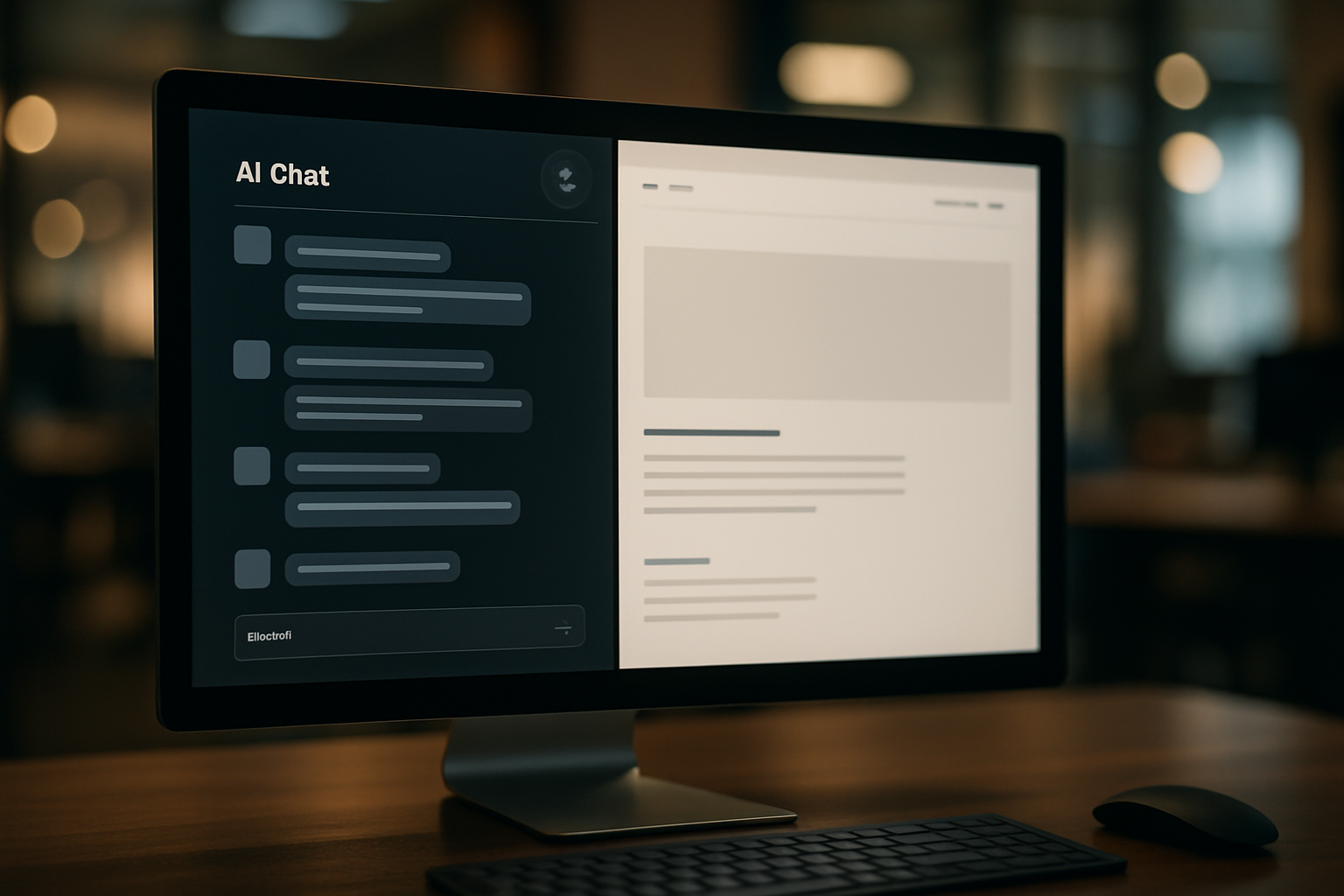
This is the headline feature. On Chrome desktop, when you click a link inside AI Mode, the webpage opens directly next to the AI interface, without replacing the search screen. You can browse the site, ask follow-up questions, and compare information. Without ever losing your search context.
Google's early testers said it themselves: they appreciated not having to « constantly switch tabs » and found the side-by-side layout « helped them stay focused on their tasks. »
For your website, this means your page will now be rendered in a fraction of the screen, typically the right half on desktop. Display width shrinks, which can break fixed-width layouts if your design isn't fully responsive.
2. Multi-tab search
On desktop and mobile, a new "+" button appears on the New Tab page and inside AI Mode. It lets users add already-open Chrome tabs to their AI Mode search. AI Mode generates contextual responses by cross-referencing the sources you're already browsing. And can recommend additional relevant sites.
Practically: a buyer comparing 3 travel booking sites can ask AI Mode to synthesize prices and conditions from their open tabs. Sites included in that synthesis get additional exposure at the most decision-critical moment.
3. Multi-input: tabs, images, PDFs
AI Mode now accepts a mix of heterogeneous sources in a single search: web tabs, images, PDF files. Canvas tools (writing, coding) and image creation are accessible directly via this "+" menu, right in the middle of a search session.
The Real SEO Impact
These numbers tell a nuanced story. The zero-click problem is already well-documented: AI Overviews have driven organic traffic down 42% across some publishing portfolios since their rollout. Side-by-side browsing doesn't solve this problem, it relocates it.
Here's what concretely changes:
- Being cited = being seen. In the side-by-side interface, your page appears at precisely the moment users are most engaged in their search. That's premium placement, but only if the AI selects you.
- Rank 1 becomes secondary. AI Mode doesn't necessarily follow organic ranking to choose its sources. A site ranked #7 with strong topical authority can be cited ahead of a generic #1.
- Display width shrinks. Your page renders at approximately 50% of the browser window. Fixed-width designs, intrusive pop-ups, and non-responsive layouts will degrade the experience. And users will close the tab.
How to Adapt: The GEO Strategy
The shift from SEO (ranking) to GEO (citability) is no longer a trend, it's an operational reality. Here are 5 concrete actions to implement now, whether you're in the US or preparing for international AI Mode rollout:
Direct answers at the top of every article
AI systems select sources that answer the question in 2-3 sentences right at the start. Structure every article with a direct answer in the first 100 words. This is what Cicero calls the « GEO hook. » AI Mode can read it, extract it, and cite your site without requiring the user to scroll.
Schema.org structured data
FAQPage, Article, HowTo, Organization, these schemas signal to Google and AI engines that your content is structured, factual, and citable. Our SEO blog has detailed implementation guides for each content type.
Named sources and verifiable data
An unsourced claim = invisible to AI. A named, dated source (« according to Ahrefs, February 2026 ») = citable. Every statistic in your content needs an author, a date, and a link. This is the single most underused GEO optimization lever.
Responsive design tested at 700px wide
Test your site at 700px width on desktop. That's the approximate render width in side-by-side mode. Remove immediate-trigger pop-ups and interstitials that degrade the experience in this layout. Check that your typography, images, and CTAs remain functional at reduced width.
Deep topical authority, not surface breadth
AI Mode selects sources perceived as experts in their niche. A well-structured semantic content cluster sends that signal. 15 expert articles on one precise topic outperforms 200 generic articles across many topics, every time.
Availability and Rollout
As of April 18, 2026, Chrome AI Mode is available in the United States only. Google has communicated « plans for international expansion » without specifying a timeline.
Two factors will likely delay the European rollout:
- The EU AI Act (progressively in force since August 2024) imposes transparency and risk assessment obligations for general-purpose AI systems. Which AI Mode could fall under.
- National data protection authorities across Europe have raised concerns about AI systems that cross-reference browsing history, tabs, and uploaded files.
This delay is an opportunity. Businesses that optimize for AI citability now will be ahead of the curve when Chrome AI Mode rolls out internationally. The citation mechanism works on the same signals Google's AI Overviews already use. And AI Overviews are live globally today.
Limitations of this article
- Traffic statistics cited (93%, 58%, +35%) come from third-party analyses (Semrush, Ahrefs, Seer Interactive) on aggregated data. Impacts vary significantly by industry and query type.
- Chrome AI Mode is US-only as of April 18, 2026. International impacts are extrapolated from US data and remain speculative.
- This article does not cover the impact on e-commerce product listings (Shopping Ads remain separate from AI Mode) or voice search.