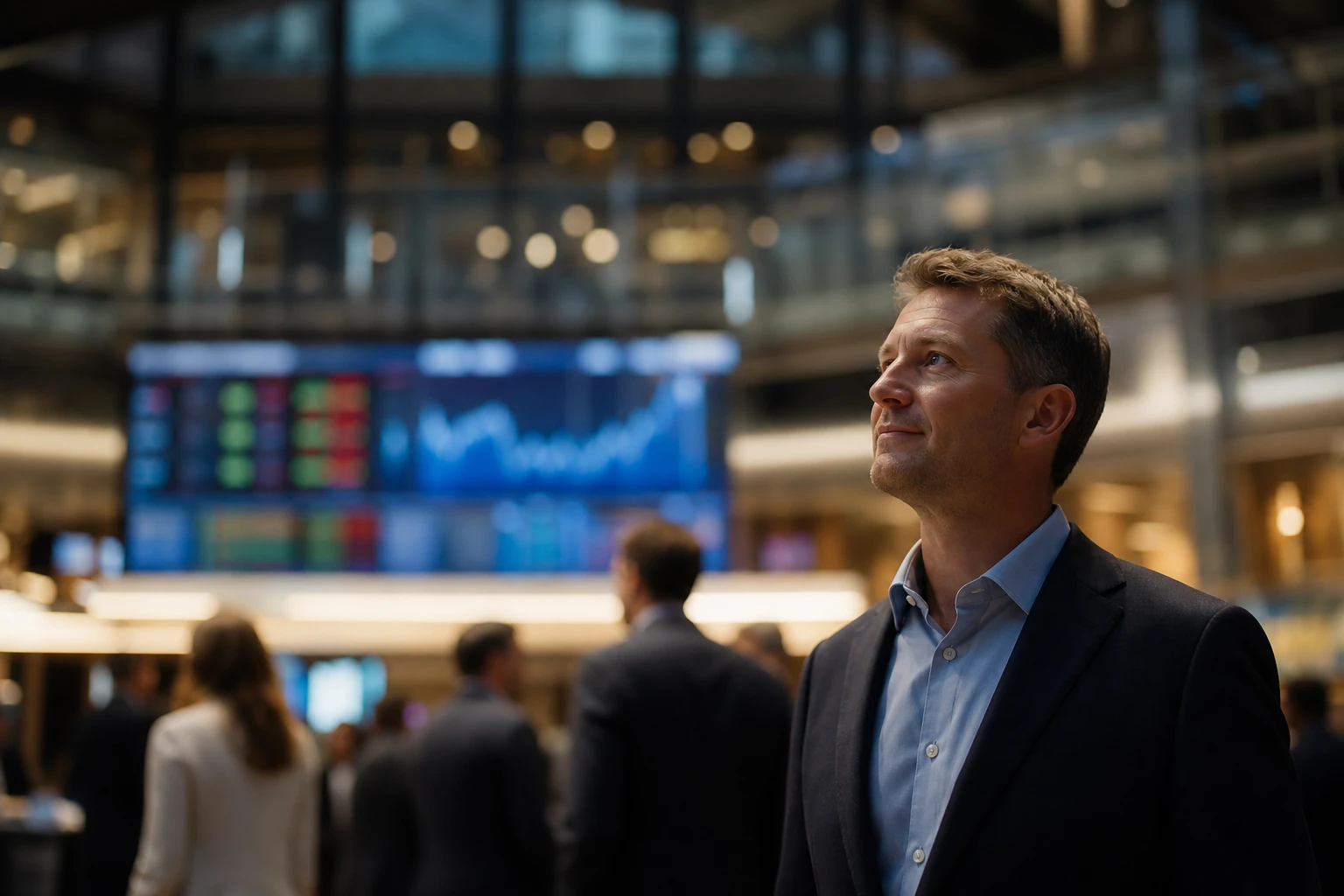
On June 1, 2026, Anthropic, the maker of Claude, confidentially submitted a draft registration statement (Form S-1) to the U.S. SEC, ahead of a planned IPO. The company posts an annualized revenue run-rate of more than $47 billion and a $965 billion valuation after its Series H round. Beyond the finance, the signal is strategic: the AI answer engines that now decide your visibility are turning into public mega-caps under monetization pressure. In practice, being cited inside the answers of Claude, ChatGPT and Perplexity is no longer a futuristic bet: it's a visibility channel to manage today.
On June 1, 2026, Anthropic, PBC confidentially submitted a draft registration statement on Form S-1 to the U.S. Securities and Exchange Commission, ahead of a proposed initial public offering of its common stock, according to a statement on its own website. Because the filing is confidential, neither the number of shares nor the price has been set. “This gives us the option to go public after the SEC completes its review,” the company said, adding that the offering “will depend on market conditions and other factors.”
With this filing, Anthropic edges ahead of rival OpenAI, which is readying its own confidential paperwork. The financial backdrop is staggering: according to TechCrunch, Anthropic's annualized revenue run-rate surpassed $47 billion, up from roughly $9 billion at the end of 2025. The company was valued at $965 billion in its Series H round ($65 billion raised), topping OpenAI's $852 billion valuation in March. Important: these figures come from press releases and reporting, not the S-1 itself, which remains confidential.
Why an IPO changes the game for your visibility
An IPO is not just a financial event: it's a change of regime. While a company is private, it can fund growth and burn capital away from the quarterly glare of public markets. Once listed, it must prove, every quarter, that it monetizes. For Anthropic, that means one simple thing: multiply and deepen the surfaces where Claude answers users directly, where the AI's answer captures attention, usage and, eventually, revenue.
And every answer formulated by an AI is an answer that doesn't necessarily send a click to your site. That's exactly the dynamic we're watching on Google, where Sundar Pichai had to publicly downplay “Google Zero”, and where AI Overviews already cover 86% of business queries in France. Anthropic's IPO confirms that this logic isn't a Google quirk: it is now the openly stated business model of an entire industry preparing for public markets.
Key takeaway: when answer engines move from startup to public mega-cap, their interest is no longer to send you traffic but to keep the user inside their answer. Your visibility increasingly plays out within that answer.
Answer-engine consolidation is concentrated risk
A year ago, the generative-AI landscape looked fragmented and uncertain. In June 2026, it is consolidating: Anthropic (~$965B) and OpenAI (~$852B) are racing toward public markets, while Google embeds Gemini at the core of Search. For an SMB, the consequence is direct: a growing share of your audience flows through a handful of interfaces that decide, by their own rules, which sources to cite. We already flagged this when Anthropic crossed a $965 billion valuation with Claude Opus 4.8.
This concentration also reaches the raw material of these engines: your content. Licensing deals are multiplying, as shown by the content licensing agreements between OpenAI and publishers, and the monetization of answers is taking shape, as seen with the arrival of an ads manager inside ChatGPT. The message is consistent: AI answers are becoming a structured economic space, with its preferred sources and, soon, its paid placements.
What to do now: 4 concrete actions
- Treat Claude as a channel, not a curiosity. ChatGPT, Claude and Perplexity are no longer gadgets: they're entry points to your prospects. Test your business queries in each and note whether, and how, your brand is cited there.
- Optimize for the citation, not just the rank. A direct answer at the top of a section, named and sourced data, self-contained statements an AI can lift without context: that's what turns content into a citable source.
- Add AI visibility to your reporting. Organic clicks alone now understate your real presence. Track your mentions in generative engines alongside your Google positions.
- Bet on non-substitutable content. An engine under monetization pressure cites what adds value to its answer, not what it can already paraphrase. A sharp angle, field expertise, original data: that's your best insurance to be cited rather than summarized.
Frequently asked questions
What did Anthropic announce on June 1, 2026?
How much is Anthropic worth, and how big is Claude?
Why does Anthropic's IPO matter for my online visibility?
Our take
At Cicéro, we read this S-1 filing as a symbolic tipping point. Claude's maker is preparing to answer to public shareholders, and a shareholder wants revenue, not traffic handed off to third parties. The direction is clear: AI answers will grow richer, get monetized, and capture more attention. The response doesn't change, it intensifies: produce the content an AI has a real reason to cite, and measure your presence inside answers, not just your rankings.
What this article does not cover: a confidential S-1 filing sets neither the date, the price, nor the final valuation of the IPO. The figures cited ($47B revenue run-rate, $965B valuation) come from press releases and reporting, not the filed document, which remains non-public. We make no prediction about the listing timeline or about the quantified evolution of web traffic tied to AI engines: that data varies widely by sector. Refer to your own measurements for your specific case.
Sources
- → Anthropic: official statement "Anthropic confidentially submits draft S-1 to the SEC" (June 1, 2026).
- → TechCrunch (June 1, 2026): “Anthropic files to go public”: revenue run-rate, valuation and the OpenAI comparison.
- → CNBC (June 1, 2026): “Anthropic confidentially files IPO prospectus with SEC”.
Growth and SEO content strategist, I founded Cicéro to help businesses build lasting organic visibility, on Google and in AI-generated answers alike. Every piece of content we produce is designed to convert, not just to exist.
LinkedIn